
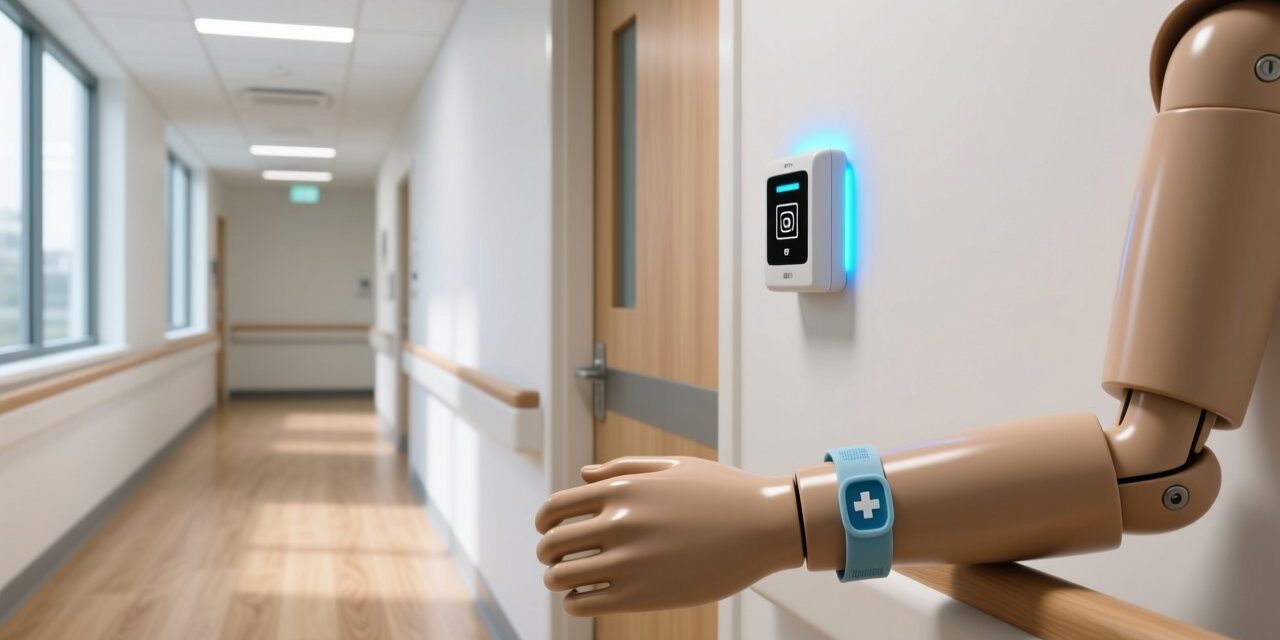
Why Wandering Prevention Is Critical in UK Care Homes
Dementia-related wandering poses serious clinical, regulatory, and operational challenges across the UK’s adult social care sector. Mit über 850,000 people living with dementia in Britain — and projections indicating this number will exceed one million by 2025 — care homes require reliable, non-intrusive, and GDPR-compliant monitoring tools. Traditional supervision models struggle to scale during staff shortages or overnight shifts, increasing risk of elopement, falls, and delayed intervention.
How RFID Technology Enables Proactive Dementia Safety
Passive RFID wristbands offer a proven, low-maintenance solution for real-time location awareness without requiring battery replacement or user interaction. Unlike GPS-based wearables, passive UHF or HF RFID systems operate within defined zones — such as doorways, stairwells, or garden exits — triggering alerts only when an at-risk resident approaches a monitored boundary. This approach conserves power, ensures privacy (no continuous location logging), and aligns with Information Commissioner’s Office (ICO) guidance on health data minimisation.
Key Technical Advantages for Care Environments
- Read Range Precision: Fixed RFID reader modules installed at strategic chokepoints provide consistent 1–3 metre detection — ideal for doorway-level alerts without false positives from adjacent rooms.
- Interoperability: Compatible with existing nurse call systems and electronic patient record (EPR) platforms via standard API integration.
- Haltbarkeit & Hygiene: Medical-grade materials withstand repeated cleaning with alcohol-based disinfectants and resist snagging on clothing or furniture.
Recommended RFID Wristbands for Dementia Care in the UK
Selecting the right wristband involves balancing comfort, Sicherheit, and system compatibility. For NHS-aligned care homes, we recommend the following verified options:
1. RFID-Silikon-Armbänder
Weiche, hypoallergenic, and adjustable, these are ideal for long-term wearers with sensitive skin or involuntary movements. Their seamless construction prevents tampering while maintaining readability through daily washing and sanitisation. RFID silicone wristbands integrate seamlessly with fixed reader modules and support both HF and UHF frequencies depending on infrastructure requirements.
2. RFID-Einweg PVC-Armbänder
For short-stay respite care or transitional assessment units, RFID disposable PVC wristbands offer tamper-evident security, quick deployment, and ISO-compliant durability. They’re particularly effective in multi-resident environments where cross-contamination risk must be minimised.
3. RFID-Stoff gewebt Armbänder
Lightweight and breathable, these are suited for residents who remain highly mobile throughout the day. The woven textile design reduces skin irritation and supports discreet identification. Available with embedded RFID fabric woven wristbands, they maintain signal integrity even under light perspiration or sleeve coverage.
Integration Considerations for NHS and CQC Compliance
UK care providers must ensure any tracking system meets the Care Quality Commission’s (CQC) Fundamental Standards — particularly Outcome 10 (Safeguarding from Abuse) and Outcome 17 (Good Governance). RFID-based wandering prevention systems should be implemented with documented consent processes, clear staff training protocols, and audit-ready access logs. No continuous geolocation data should be stored; instead, event-triggered logs (e.g., ‘Door A exit alert at 02:14’) satisfy both clinical accountability and data protection principles.
Real-World Deployment Best Practices
- Install fixed RFID reader modules at all external doors, fire exits, and high-risk internal thresholds (e.g., basement stairs).
- Pair with wall-mounted visual alerts or integrated nurse call pagers to reduce response time.
- Conduct quarterly system calibration and tag-read reliability tests — especially after seasonal uniform changes or new furniture layouts.
- Train staff on escalation pathways: e.g., Level 1 (visual confirmation), Level 2 (team mobilisation), Level 3 (external liaison).
FAQ
- Are RFID wristbands compliant with UK GDPR and NHS Digital standards?
- Yes — passive RFID systems used for boundary detection do not collect or store personal location history. Alerts are event-based and logged only with time/date/staff ID, satisfying ICO’s Data Protection Impact Assessment (DPIA) criteria for health monitoring tools.
- Can these wristbands be worn by residents with pacemakers or other medical devices?
- All recommended wristbands use passive HF or UHF RFID chips operating far below electromagnetic interference thresholds outlined in MHRA guidelines. No active transmission occurs from the wristband itself.
- Do RFID wristbands require charging or battery replacement?
- No — passive RFID wristbands contain no internal power source. They draw energy wirelessly from the reader module during interrogation, ensuring zero maintenance downtime.
- How do I integrate RFID alerts with our existing nurse call system?
- Most modern nurse call platforms accept HTTP POST or Modbus TCP inputs. Our RFID reader module supports configurable webhook delivery for seamless interoperability.
Secure Your Care Home With Proven RFID Safety Solutions
Reduce wandering incidents, strengthen CQC compliance, and empower your team with reliable, UK-tested RFID wristband technology. Request a free technical consultation and site-specific hardware recommendation today.