
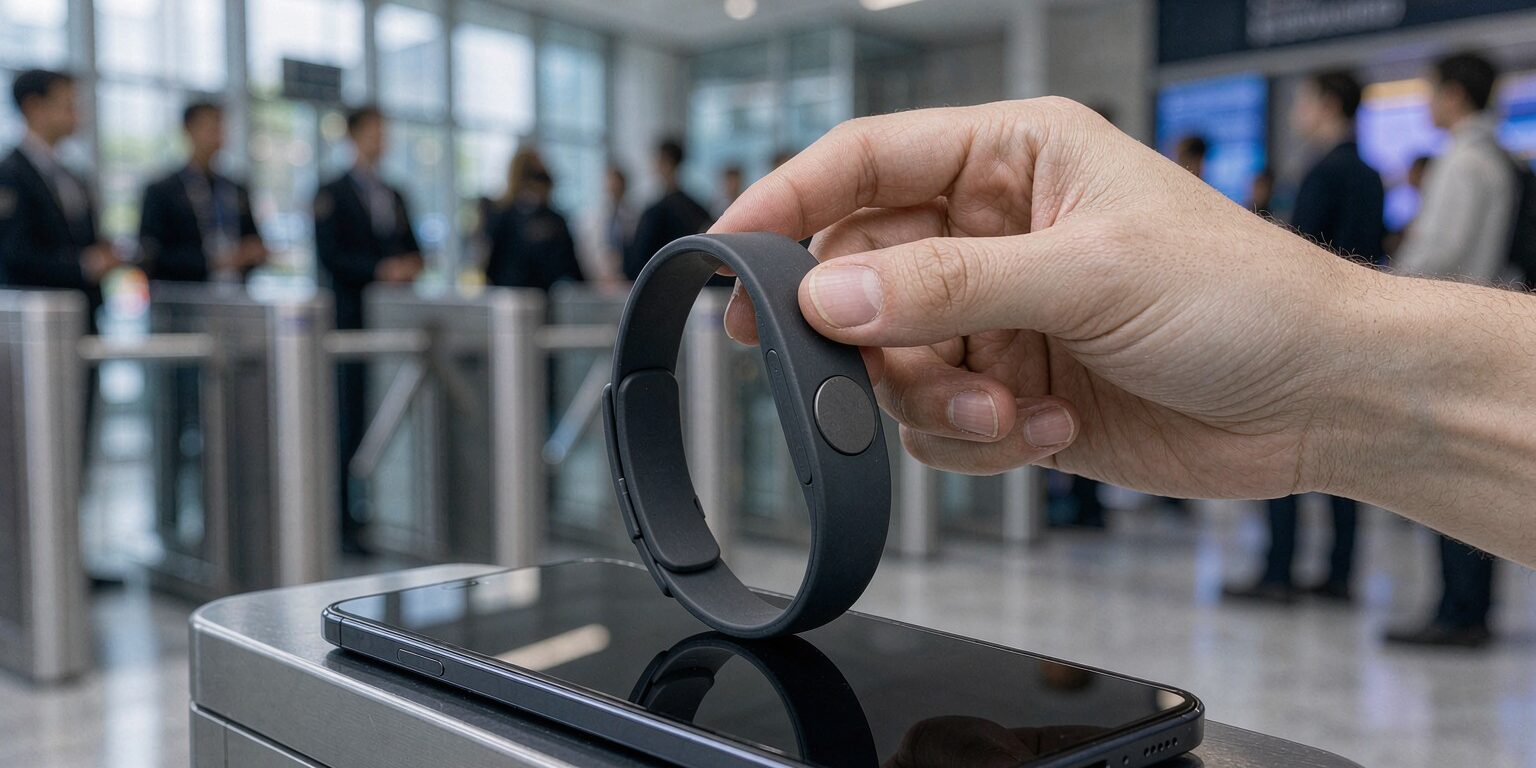
When deploying RFID wristbands for events, Santé, hospitality, or industrial tracking, the first technical decision is often frequency. Two options dominate: HF-NFC, operating at 13.56 MHz, et UHF RFID, operating in the 860–960 MHz band. Each frequency has different strengths in read range, data transfer, sécurité, cost, and reader ecosystem.
The right choice depends on how far away you need to read a wristband, how many wristbands you need to scan at once, and whether the wearer will interact with a smartphone. This guide compares HF vs UHF RFID wristbands in practical terms for technical buyers.
Understanding RFID Frequency Basics
What Is HF-NFC RFID?
HF stands for high frequency. HF RFID operates at 13.56 MHz and follows standards such as ISO 14443 and ISO 15693. Nfc, or near-field communication, is a subset of HF RFID that enables smartphone interaction. An NFC wristband can be tapped by a phone to open a URL, trigger an app, or authorize a payment. Read range is intentionally short—typically a few centimeters—which improves security and reduces accidental reads in crowded spaces.
What Is UHF RFID?
UHF stands for ultra-high frequency. UHF RFID operates between 860 MHz and 960 MHz, depending on regional regulations. It is the foundation of RAIN RFID technology and is widely used in supply chain, Logistique, and automated access control. A long-range RFID wristband using UHF can be read from several meters away, even when the wearer is moving or the wristband is partially obscured.
Key Technical Differences Between HF-NFC and UHF RFID Wristbands
The table below summarizes the main engineering and operational differences that influence wristband selection.
| Feature | HF-NFC RFID Wristband | UHF RFID Wristband |
|---|---|---|
| Frequency band | 13.56 MHz | 860–960 MHz (region-dependent) |
| Typical read range | 1–10 cm | 1–12 m or more depending on reader and environment |
| Simultaneous reads | Limited anti-collision; usually one tag at a time or small batch | Strong anti-collision; hundreds of tags per second |
| Data transfer speed | Lower to moderate | Higher, optimized for fast inventory and gate entry |
| Memory | Commonly up to a few kilobytes; NDEF format on NFC | Typically smaller EPC and user memory; optimized for ID and sensor data |
| Smartphone interaction | Oui, native NFC support on most modern phones | Generally no native support; requires a UHF reader or sled |
| Security | Short range reduces interception; supports encryption and secure elements | Longer range requires command passwords and careful access control |
| Cost profile | Moderate; NFC chips may add premium | Often lower cost at high volumes for passive tags |
| Typical wristband formats | RFID silicone wristbands, Pvc, papier, Tissu | Fabric woven, Plastique, thermal, disposable paper, silicone with tuned antenna |
| Best for | Contactless payment, secure access, smartphone engagement, product authentication | Long-range access, gate entry, vehicle or crowd flow, inventory-style tracking |
Reader and Infrastructure Considerations
Your choice of frequency also affects the reader network and total cost of ownership.
HF-NFC Reader Infrastructure
HF-NFC wristbands work with widely available NFC-enabled POS terminals, access readers, and smartphones. This lowers hardware cost for payment and engagement use cases, but each interaction is usually one-to-one. If you need to process high volumes at a gate, HF-NFC may require more lanes or staffed tap points.
UHF Reader Infrastructure
UHF RFID requires dedicated fixed or handheld readers and antennas. The initial hardware cost can be higher, but the throughput advantage is significant for automated entry, vehicle gates, and crowd-flow monitoring. UHF gate portals can read many wristbands simultaneously without staff intervention.
Real-World Use Cases for HF-NFC Wristbands
Cashless Payments and Secure Access
Because of the short read range and native phone support, HF-NFC is the standard for payment and high-security access. A wristband worn on the wrist can be tapped at a point-of-sale terminal or door reader without the user removing it. The short read distance also prevents accidental cross-reads in dense queues or VIP lanes.
Smartphone Engagement and Loyalty
HF-NFC wristbands allow guests to tap their own phone against the wristband or tap the wristband against an NFC-enabled kiosk. This is useful for lead capture, social media check-ins, loyalty programs, and product authentication. If your project requires user interaction with a phone, NFC wristband technology is usually the better choice.
Real-World Use Cases for UHF RFID Wristbands
Long-Range Entry and Vehicle Access
UHF RFID is ideal when you need to read wristbands from a distance without slowing down the wearer. Gates at festivals, stadiums, parking areas, and secured facilities can identify many people or vehicles quickly. A long-range RFID wristband can be read while a guest walks through a portal, hands-free.
High-Throughput Asset and Personnel Tracking
For operations that resemble logistics—such as tracking staff zones, monitoring patient flow, or counting attendees at multiple checkpoints—UHF delivers high-speed multi-tag reads. This makes UHF suitable for RFID disposable paper wristbands used in high-volume single-day events, as well as reusable formats.
How to Choose the Right Frequency for Your Project
Use these questions to narrow the decision:
- Do users need to tap with a smartphone? If yes, choose HF-NFC.
- Do you need to read from more than 1 Compteur? If yes, choose UHF.
- Do you need to scan hundreds of wristbands per minute? UHF anti-collision is stronger.
- Is security the primary concern? Short-range HF-NFC is easier to control.
- Are you managing inventory or asset-like flows? UHF aligns with RAIN RFID systems.
- Do you need a low-cost disposable wristband for mass distribution? Both are available; material and inlay choice matter.
For many deployments, the material and form factor matter as much as frequency. RFID thermal wristbands are often chosen for on-demand printing, while silicone and fabric options support longer wear. Confirm with your supplier that the inlay and antenna are optimized for your selected frequency and environment.
Frequently Asked Questions
Can UHF RFID wristbands be read by a smartphone?
Generally no. Most smartphones include NFC readers, not UHF RFID readers. UHF wristbands require a dedicated fixed or handheld UHF reader to scan at longer distances.
Which frequency is more secure for wristband access control?
Both can be secured, but HF-NFC has a shorter read range, which reduces the risk of unauthorized reading. If UHF is used for access control, implement command passwords and reader authentication.
Can I combine HF and UHF in one wristband?
Dual-frequency wristbands exist but are generally more expensive and may be thicker. Most projects choose one frequency to simplify the inlay, reader infrastructure, and per-unit cost.
What is the typical read range difference between HF-NFC and UHF?
HF-NFC wristbands typically read within 1–10 cm. UHF RFID wristbands can be read from 1 À 12 meters or more, depending on the reader, antenna, tag design, and environment.
Which is better for cashless payments at festivals?
HF-NFC is usually better for cashless payments because point-of-sale terminals and smartphones support NFC natively. The short read range also prevents accidental cross-reads in crowded queues.
Get Expert Help Choosing the Right RFID Wristband Frequency
RFIDHY provides custom HF-NFC and UHF RFID wristbands in silicone, Tissu, papier, Pvc, and thermal formats. Our team can help you select the right frequency, Puce, and antenna for your event, Santé, hospitality, or industrial application.