
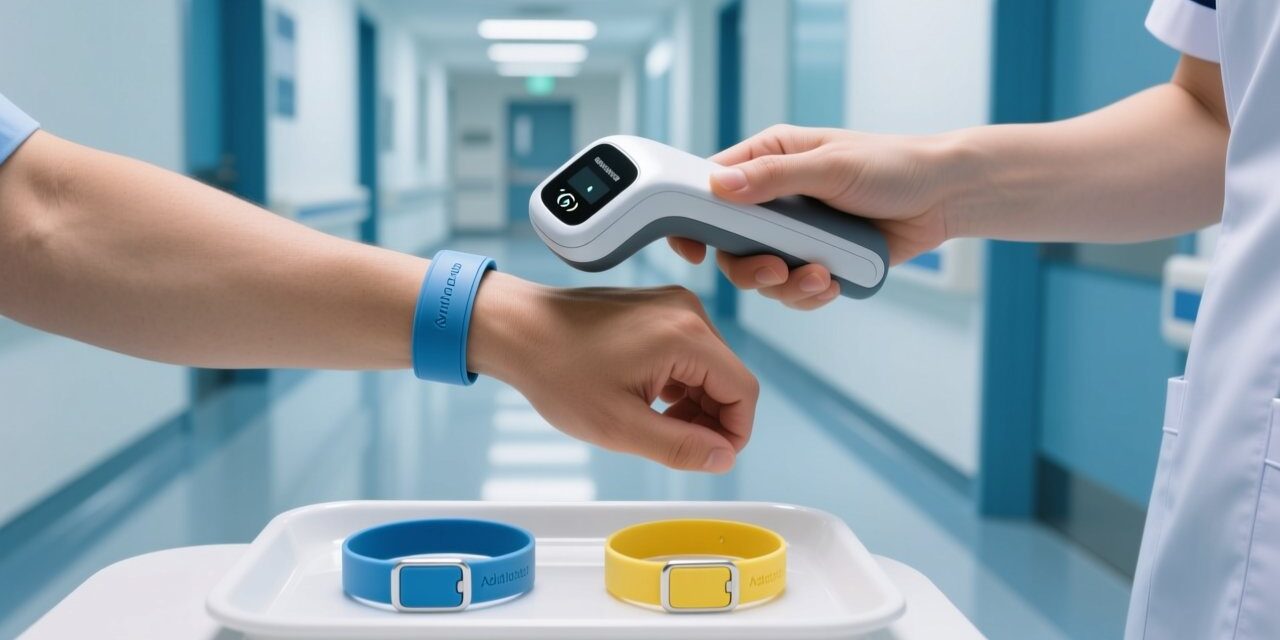
Hospitals face a persistent challenge: reliably identifying patients at every point of care. Manual identification checks, look-alike names, and worn barcode wristbands can contribute to medication errors, transfusion mistakes, and wrong-patient procedures. RFID patient wristbands address these risks with contactless, durable identification that links each patient to the correct electronic health record.
This guide is written for hospital administrators, nursing directors, and health IT managers who are evaluating or implementing an RFID patient identification system. It covers patient safety benefits, HIPAA compliance considerations, a barcode vs RFID comparison, RFIDHY wristband specifications, and a step-by-step implementation workflow.
Why Patient Identification Is a Patient Safety Priority
Accurate patient identification is the foundation of safe care delivery. Hospital patient identification errors can lead to medication administration to the wrong patient, incorrect blood transfusions, missed lab tests, and wrong-site procedures. Regulatory and accreditation bodies consistently identify correct patient identification as one of the most critical patient safety goals.
An RFID patient wristband supports positive patient identification by enabling clinicians to scan the wristband at the bedside and automatically match the patient to the correct electronic health record. This reduces manual data entry and helps prevent wrong-patient actions. For nursing directors and health IT managers, RFID patient identification is a practical way to reinforce patient safety protocols without slowing down clinical workflows.
Patient safety wristbands must be reliable in demanding hospital environments. They need to survive handwashing, showering, bodily fluids, and extended wear. Traditional barcode wristbands can become unreadable when wet or creased, but RFID wristbands remain readable because they do not require a clean, flat surface or direct line of sight.
Closed-loop medication administration is one of the strongest use cases. When a nurse scans an RFID patient wristband before giving medication, the system can automatically validate the “five rights” of medication administration against the active orders in the EMR/EHR. Any mismatch triggers an alert, which helps reduce medication errors and wrong-patient procedures at the point of care.
What Is an RFID Patient Wristband and How Does It Work?
A hospital patient ID wristband with RFID contains a small passive HF RFID tag and an antenna embedded in a waterproof wristband material. The tag does not require a battery. When a nurse or technician brings an RFID reader within a few centimeters, the tag draws power from the reader’s electromagnetic field and returns its unique identifier (UID).
Importantly, an RFID patient wristband stores no protected health information on the chip. It contains only an encrypted UID that links to the patient’s record in a secure backend database. This design is central to HIPAA-compliant patient identification because it minimizes the amount of sensitive data that could be exposed if a wristband is lost, removed, or discarded.
Read range depends on the chip standard. For ISO14443A chips, the typical read range is 2–5 cm. For ISO15693 chips, the range extends to 2–8 cm. These short read ranges are intentional in hospital environments. They support deliberate bedside scanning and reduce the risk of accidentally reading the wrong patient’s wristband in a crowded bay.
RFIDHY supplies medical wristband RFID solutions that combine reliable identification with patient comfort. The PVC wristband model HYWSJ01 has a length of 245 mm, suitable for adult patients. The plastic ring wristband model HYWSJ02 is available in diameters of 55 mm, 58 mm, 64 mm, and 74 mm, which accommodates newborn and adult sizing options.
Barcode vs RFID Patient ID: Choosing the Right Hospital Wristband System
Many hospitals already use barcode wristbands for medication administration. Barcode patient ID systems are cost-effective and widely supported by Zebra thermal printers and pharmacy dispensing systems. However, barcode scanning requires direct line of sight. A wrinkled, wet, or partially covered barcode may fail to scan, causing nurses to type patient identifiers manually or override safety alerts.
RFID patient identification uses contactless reading. The wristband can be read even if it is under a sleeve, wet, or slightly obscured. This improves scanning success at the point of care and reduces friction during medication administration, specimen collection, and blood transfusion verification.
The table below compares barcode and RFID patient ID wristbands for hospital use.
| Feature | Barcode Patient ID Wristband | RFID Patient ID Wristband |
|---|---|---|
| Reading method | Line-of-sight optical scanning | Contactless radio frequency reading |
| Read range | Typically 10–30 cm with barcode scanner | ISO14443A: 2–5 cm; ISO15693: 2–8 cm |
| Durability | Can become unreadable when wet, creased, or scratched | Waterproof and tamper-evident; continues working after exposure to moisture |
| Data on wristband | Printed patient ID and barcode only | Encrypted UID only; no PHI stored on chip |
| Patient data storage | Linked to backend database by scanned barcode | UID links to backend database; EMR/EHR integration displays record |
| Typical hospital applications | Medication administration, lab specimen labeling | Bedside verification, patient tracking RFID, access control, infant security |
| Printing/encoding | Zebra thermal printers print barcode | Zebra thermal printers with RFID encoding module print and encode in one step |
For hospitals moving toward contactless workflows, a hospital wristband system based on RFID can reduce scanning failures and improve nursing efficiency. That said, barcode and RFID often coexist during transition periods, and both can interface with the same EMR/EHR middleware.
HIPAA-Compliant RFID Patient Wristbands: Data Privacy by Design
A common misconception is that RFID wristbands store medical records or protected health information on the chip. They do not. A HIPAA compliant wristband stores only an encrypted UID. The patient’s name, diagnosis, medications, lab results, and other PHI remain in the hospital’s electronic medical record system, protected by user authentication, role-based access controls, and audit logging.
This architecture limits the risk of a lost or stolen wristband. Even if someone reads the UID, they cannot access PHI without also having authorized access to the hospital’s backend database and the associated clinical application. Hospitals should still apply physical and technical safeguards, such as encrypting database connections, restricting reader access, and deactivating UIDs after discharge.
When implemented correctly, RFID patient identification supports HIPAA Security Rule requirements for access control, audit controls, and integrity. IT teams should document how the UID is generated, how it is linked to the patient record, and how access is revoked when care is completed. This documentation helps demonstrate compliance during audits and risk assessments.
For hospitals evaluating RFID tags in other healthcare settings, RFID wristbands for healthcare and fitness provide similar contactless identification capabilities with encrypted identifiers.
RFIDHY Hospital Wristband Options: PVC and Plastic Ring Designs
RFIDHY offers two primary hospital patient identification formats designed for different clinical needs.
HYWSJ01 PVC Wristband
The RFID disposable PVC wristband HYWSJ01 measures 245 mm in length and is suitable for adult patients. The PVC material is waterproof, durable, and tamper-evident, making it appropriate for long hospital stays. A tamper-evident closure shows visible signs if someone tries to remove or swap the wristband, which supports patient safety and infant security protocols.
HYWSJ02 Plastic Ring Wristband
The RFID plastic wristband HYWSJ02 is a ring-style wristband offered in multiple diameters: 55 mm, 58 mm, 64 mm, and 74 mm. These size options cover newborn and adult patients, and the ring design is lightweight and comfortable for extended wear. The plastic ring wristband also supports waterproof and tamper-evident features, and it can be paired with ISO14443A or ISO15693 chips according to the hospital’s read range requirements.
Both formats are compatible with standard RFID encoding workflows, including Zebra thermal printers that have RFID encoding capability. Hospitals can choose the form factor that best matches their patient population, wristband printers, and clinical workflows.
EMR/EHR Integration and Zebra Thermal Printer Workflow
Implementing RFID patient wristbands does not require replacing your EMR/EHR. The wristband UID is simply another identifier that points to the patient record. Integration typically occurs through middleware or an interface engine that maps RFID UID reads to the correct patient encounter in the EMR/EHR.
A common workflow looks like this:
- Patient registration creates an encounter and assigns a unique patient identifier.
- The RFID encoding system generates an encrypted UID and links it to that patient identifier in the database.
- A Zebra thermal printer with RFID encoding prints the patient’s name, date of birth, and barcode on the wristband while encoding the UID into the embedded RFID chip.
- The clinician scans the wristband with a bedside RFID reader.
- The reader sends the UID to the middleware, which retrieves the correct patient record from the EMR/EHR.
- The clinician verifies the patient identity and performs the ordered task, such as medication administration or specimen collection.
This approach supports patient tracking RFID without storing clinical data on the wristband. It also works with passive RFID wristbands, so there is no battery to replace and no maintenance burden on nursing staff.
For hospitals that already use Zebra thermal printers, adding RFID encoding may require an upgrade or a dedicated RFID print-and-encode station. IT teams should confirm the printer supports the selected chip standard and that the encoding software can write the UID and print the wristband in one pass without slowing admission workflows.
Implementation Workflow for Hospital Patient Identification Systems
Successful deployment of a hospital patient identification system based on RFID requires coordinated planning across nursing, IT, admitting, and pharmacy departments. The following steps provide a practical implementation framework.
1. Define Clinical Use Cases
Start by identifying where positive patient identification has the greatest impact: medication administration, blood transfusion verification, specimen collection, newborn identification, or procedural area checks. Document current barcode failure rates and manual workarounds to build the case for RFID.
2. Select Wristband Format and Chip Standard
Choose between PVC and plastic ring wristbands. For adult inpatient units, HYWSJ01 PVC wristbands provide a familiar band style. For maternity and pediatric units, HYWSJ02 plastic ring wristbands in multiple diameters support newborn and adult sizing. Select ISO14443A for a 2–5 cm read range or ISO15693 for a 2–8 cm read range based on reader placement and bedside workflow.
3. Validate EMR/EHR Integration
Work with your EMR/EHR vendor or integration partner to map RFID UID reads to patient encounters. Confirm that the middleware can handle UID generation, patient record matching, and audit logging. Test in a staging environment before go-live.
4. Configure Zebra Thermal Printers
Deploy or upgrade Zebra thermal printers with RFID encoding capability. Verify that the printer can encode the selected chip standard and print patient demographics on the wristband surface. Establish label stock that remains readable and comfortable for the expected length of stay.
5. Train Nursing and Admitting Staff
Train staff on correct wristband placement, scanning distance, and what to do if a wristband is damaged or unreadable. Reinforce that the RFID chip contains only an encrypted UID and that patient data remains in the EMR/EHR. Provide quick-reference guides for bedside scanning.
6. Conduct a Pilot and Monitor Performance
Run a pilot on one unit before hospital-wide rollout. Track scanning success rates, time to patient identification, medication administration compliance, and staff feedback. Use this data to adjust reader placement, wristband sizing, and training materials.
Best Practices for Nursing and IT Teams
To get the most value from RFID patient identification, hospitals should adopt consistent operational practices around wristband management and data governance.
- Place the wristband on the correct limb and scan at every critical step. Consistent placement reduces scanning variation and supports rapid verification.
- Keep the wristband visible but avoid placing it over wounds or IV sites. RFID contactless reading works even if the wristband is slightly covered, but patient comfort and clinical access remain top priorities.
- Deactivate UIDs at discharge. Remove the link between the UID and the patient record in the backend database to prevent unauthorized re-association.
- Document RFID workflows in policies and procedures. Include how UIDs are generated, linked, accessed, and retired. This supports HIPAA compliance and audit readiness.
- Monitor read failures and user workarounds. If nurses frequently type patient identifiers manually, investigate whether readers, wristbands, or EMR integration need adjustment.
RFIDHY provides RFID medical wristbands that are waterproof, tamper-evident, and designed for long hospital stays. For a hospital-specific assessment or sample request, contact the RFIDHY team.
FAQ
Does an RFID patient wristband store protected health information?
No. A HIPAA compliant RFID patient wristband stores only an encrypted UID. The UID links to the patient’s record in a secure backend database. PHI remains in the EMR/EHR and is not written to the wristband chip.
Is RFID patient identification HIPAA compliant?
Yes, when implemented correctly. HIPAA does not mandate a specific technology. RFID patient identification supports compliance by minimizing data stored on the wristband, using encrypted UIDs, and requiring backend access controls, audit trails, and user authentication.
What read range should hospitals expect from RFID patient wristbands?
Read range depends on the chip standard. ISO14443A chips typically read at 2–5 cm. ISO15693 chips read at 2–8 cm. These short ranges support deliberate bedside scanning and reduce the risk of reading the wrong patient’s wristband.
Are RFIDHY patient wristbands waterproof and tamper-evident?
Yes. RFIDHY PVC and plastic ring wristbands are waterproof and tamper-evident, making them suitable for handwashing, showering, and long hospital stays. Tamper-evident closures show visible signs if someone tries to remove or swap the wristband.
What sizes are available for RFID patient wristbands?
RFIDHY offers the HYWSJ01 PVC wristband at 245 mm for adult patients. The HYWSJ02 plastic ring wristband is available in 55 mm, 58 mm, 64 mm, and 74 mm diameters to accommodate newborn and adult patients.
How does RFID integrate with EMR/EHR and Zebra thermal printers?
RFID wristbands integrate through middleware that maps the RFID UID to the patient encounter in the EMR/EHR. Zebra thermal printers with RFID encoding capability print patient demographics and encode the UID into the wristband chip in one step.
Ready to Implement RFID Patient Identification?
RFIDHY provides durable, waterproof, and tamper-evident RFID patient wristbands for adult and newborn patients. Whether you need the 245 mm HYWSJ01 PVC wristband or the multi-diameter HYWSJ02 plastic ring wristband, our team can help you select the right format, chip standard, and integration path for your EMR/EHR workflow.
Explore RFIDHY medical wristbands or contact our team for a hospital-specific consultation and sample request.