
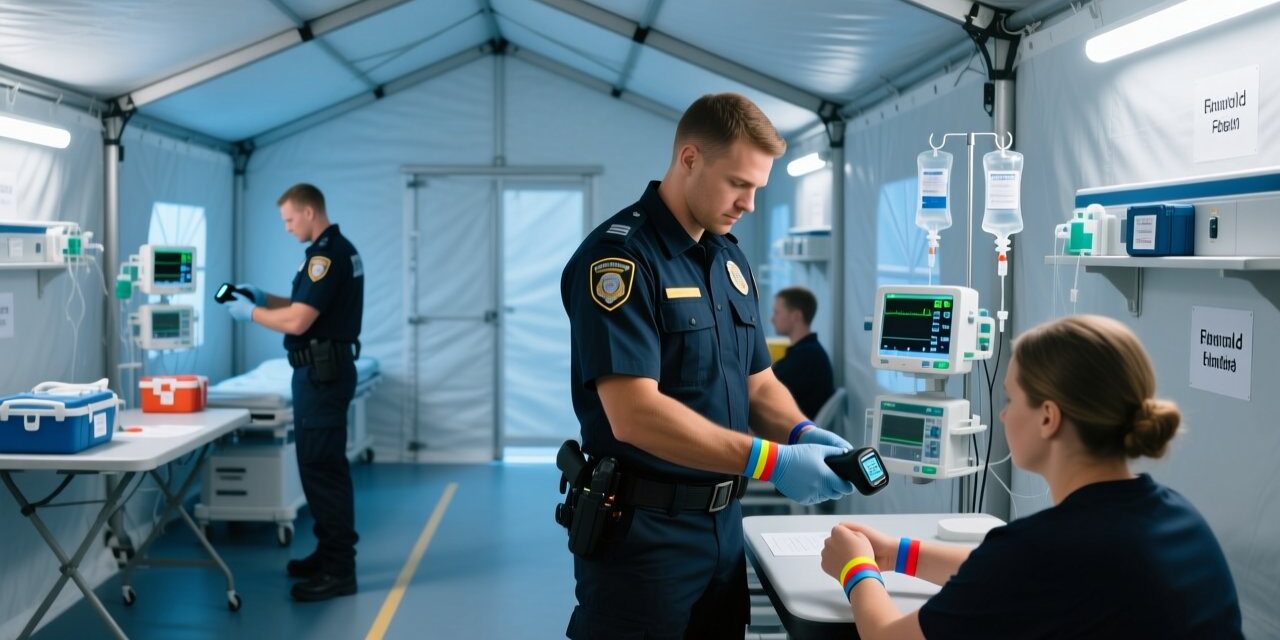
In a mass casualty incident (MCI), patient identification can determine whether triage resources are allocated correctly. Emergency medical services, disaster response coordinators, and hospital emergency department managers increasingly rely on RFID-Tags embedded in lightweight wristbands to support rapid patient registration, patient movement tracking, and family reunification. This guide explains how a hospital RFID wristband works within a disaster response workflow and what to look for when selecting field-ready triage identification.
The Mass Casualty Identification Challenge
During a disaster, responders often receive multiple patients at once with limited demographic information. Traditional paper triage tags can tear, become illegible in wet conditions, or detach during transport. Manual registration creates duplicate records, delays treatment decisions, and makes it difficult to locate individual patients later. A disaster patient triage RFID approach addresses these gaps by combining visual triage color coding with digital identification that can be read instantly at multiple points along the care continuum.
For emergency medical services, the need is straightforward: assign a unique identifier at first contact and maintain that link from the incident scene through ambulance transport to the receiving facility. For hospital emergency department managers, the same identifier should support arrival logging, electronic health record linkage, and downstream patient tracking. A mass casualty RFID wristband serves as that common data anchor without requiring responders to type or write patient details in chaotic field conditions.
Why RFID Wristbands Fit Emergency Triage Workflows
An RFID wristband is a lightweight patient identifier containing a passive RFID chip and antenna. It does not require a battery, withstands field conditions, and can be read through clothing or modest environmental interference. In an MCI, the wristband supports three core functions: rapid triage classification, instant patient registration, and continuous movement tracking.
Unlike barcode-based processes that demand line-of-sight scanning, RFID-enabled emergency patient identification allows multiple wristbands to be read quickly with a compatible reader. This capability is particularly valuable during patient surges, when responders may be wearing gloves, working in low light, or moving patients rapidly through triage stations.
Emergency department RFID workflows also benefit because the same wristband that was applied in the field can be read at the hospital entrance, in imaging, in the operating room, or in temporary observation areas. This reduces duplicate documentation and improves continuity of care for severely injured patients.
Rapid Triage: Color-Coded RFID Wristbands at the Scene
The visual layer of a triage wristband RFID system remains critical. Responders can identify acuity at a glance using familiar color conventions, while the RFID chip stores the corresponding triage level and timestamp. This allows the wristband to function both as a traditional color marker and as a machine-readable record of triage priority.
The table below shows how standard triage colors map to RFID encoding logic.
| Triage Level | Color Code | Typical RFID Encoding | Field Response |
|---|---|---|---|
| Immediate | Rot | Priority 1 flag with timestamp | Immediate life-saving intervention |
| Delayed | Gelb | Priority 2 flag with reassessment timer | Urgent but can wait for short interval |
| Minor | Grün | Priority 3 flag with ambulatory record | Delayed care or holding |
| Deceased/Expectant | Schwarz | Log only, no active treatment queue | Documentation and transfer |
Pre-printed color wristbands for immediate deployment are especially useful at the scene. Responders can open a sealed kit, apply red, yellow, or green wristbands without waiting for on-site printing, and then encode or read the RFID chip as the patient moves into the treatment area. This combination reduces setup time and ensures consistent visual communication across multiple agencies.
Instant Patient Registration: Tap to Record Arrival
Rapid patient registration is one of the strongest operational benefits of mass casualty identification. Instead of transcribing a name or assigning a paper number, a responder taps the wristband with a handheld RFID scanner and the system records the arrival event with a date and time stamp. This tap-to-record workflow works even when the patient is unresponsive, unidentified, or accompanied only by family members with limited information.
In a disaster response wristband deployment, each tap can update the patient record with location, assigned acuity, transport status, and care milestones. Emergency department staff then receive an accurate arrival list without relying on separate paper logs or radio reports. For mass casualty RFID wristband programs, the goal is not to replace clinical judgment but to remove administrative friction that slows clinicians during a surge.
Tracking: Patient Movement Through Treatment
EMS patient tracking becomes more reliable when the identifier follows the patient physically. RFID wristbands allow each movement from triage to treatment, from treatment to transport, and from transport to hospital handoff to be recorded with a quick read. In a large incident, this supports command staff who need to know how many patients are in each treatment area and where available capacity exists.
Hospitals can install temporary or permanent readers at ambulance entrances, emergency department corridors, radiology suites, and transfer points. Every read creates an audit trail that helps managers locate patients, identify bottlenecks, and allocate staff to areas with the highest demand. Because the wristband remains attached during transport, the emergency department RFID record reflects the patient’s actual care journey rather than an assumed location.
Field Hospital: Temporary RFID Infrastructure
Field hospital RFID deployments require lightweight, quickly deployable reader infrastructure. In many cases, this means handheld readers issued to triage officers, treatment area leads, and patient movement coordinators. In larger field hospitals, fixed readers can be mounted at zone entrances or placed on portable stands. Because the RFID chip is passive, the wristband itself does not need charging or network connectivity.
Temporary infrastructure should be planned as part of the disaster response workflow. Agencies can pre-stage reader kits, battery packs, and spare wristbands in response trailers. This allows a field hospital to begin registering and tracking patients within minutes of setup. The same wristband format can then be used during inter-facility transfers, so the patient record remains continuous from the incident scene through definitive care.
Durable: Withstands Field and Transport Conditions
Field conditions place extreme demands on identification media. A disaster response wristband must survive physical movement, repeated handling, and exposure to dirt, blood, and medical fluids. RFID wristbands made from PVC or silicone are commonly selected for these scenarios because they resist tearing and remain legible throughout transport.
RFID disposable PVC wristbands offer a practical balance of durability and cost for single-incident use. They can be applied quickly, remain secured with a tamper-evident locking mechanism, and are difficult to remove without cutting. For longer deployments or repeated use, RFID silicone wristbands provide an even more rugged option that can withstand repeated cleaning.
Wasserdicht: Rain, Fluids, and Decontamination
Water resistance is essential for mass casualty and disaster patient triage. Responders may work in rain, patients may be exposed to blood or irrigation fluids, and some incidents require gross decontamination before treatment. A waterproof RFID wristband protects the chip and antenna from moisture, maintaining readability even after water exposure. This is a significant advantage over paper tags or printed labels that can degrade quickly.
In decontamination scenarios, the wristband should remain attached to the patient or be removed only as directed by clinical protocols. Waterproof designs also reduce the risk of skin irritation when patients wear the wristband for extended periods during observation or transfer. RFID thermal wristbands can be useful when on-site printing is available, while pre-printed waterproof options support immediate deployment at the scene.
Family Reunification: Family Location of Patients
Family reunification is a critical but often overlooked component of disaster response. When patients are transported to different hospitals or treated at a field facility, family members may have no central source of accurate location information. RFID-based patient tracking supports reunification by recording each read event and making that location data available to authorized family assistance center staff.
Because the wristband stores a unique identifier, family members can be linked to a patient record without needing to identify the patient visually. This is especially valuable when patients are unconscious, sedated, or otherwise unable to communicate. The same identifier can also support matching of separated children or dependents with guardians through established reunification protocols.
Integration with Disaster Management Systems
RFID wristbands deliver the most value when integrated with disaster management systems, hospital admission systems, and electronic health records. Integration allows triage data captured in the field to flow directly into the receiving facility without manual re-entry. This reduces duplicate records, prevents information loss between agencies, and gives command staff a common operating picture.
Integration can be as simple as exporting a list of scanned wristband identifiers from a mobile reader, or as advanced as real-time API connections to a hospital information system. The appropriate architecture depends on the size of the response operation and the available connectivity. In disconnected environments, handheld readers can store reads locally and synchronize when connectivity is restored.
Selecting the Right RFID Wristband for Emergency Medical Services
There is no single wristband format that suits every incident. EMS agencies and hospitals should evaluate wristband options based on deployment speed, environmental exposure, reading distance, and integration requirements. Key considerations include the locking mechanism, comfort for long wear, color visibility, and whether the wristband must be printed on site or can be stocked as pre-printed color bands.
For rapid deployment, pre-printed color wristbands for immediate deployment are often the most practical choice. They eliminate the need for a printer in the field and ensure that every responder sees the same visual acuity code. For facilities that prefer to print patient-specific text or barcodes at admission, thermal or PVC wristbands with RFID encoding may be more appropriate.
RFIDHY offers a range of field-ready wristband formats that can support emergency patient identification and disaster response workflows. Explore RFIDHY’s medical wristbands page to review options for triage, patient tracking, and emergency department use.
Implementation Checklist for RFID Triage Deployment
- Stock pre-printed color wristbands: Maintain red, yellow, green, and black options in response kits for immediate deployment.
- Pre-configure handheld readers: Ensure reader devices are charged, updated, and paired with disaster management software before an incident occurs.
- Define triage workflow roles: Assign specific staff or responders to handle patient registration, Bewegungsverfolgung, and family reunification data.
- Plan for connectivity loss: Use readers that store data locally and sync when network access returns.
- Test waterproof and durability requirements: Confirm that selected wristbands survive exposure to water, fluids, and transport conditions.
- Coordinate with receiving hospitals: Agree on identifier formats and integration points so field data flows into emergency department RFID systems without delay.
Preparedness Starts with the Right Identification Layer
RFID wristbands for mass casualty and disaster patient triage are not a replacement for clinical protocols. They are an enabling layer that helps emergency medical services and hospitals execute those protocols more efficiently. By combining visual triage color coding with digital identification, responders can register patients faster, track movement more accurately, and support family reunification with greater confidence.
Organizations that prepare RFID triage infrastructure in advance are better positioned to manage the administrative complexity of a mass casualty event. Whether the need is a durable PVC wristband for a field hospital or a waterproof silicone format for decontamination zones, selecting the right disaster response wristband is a practical step toward stronger emergency preparedness.
FAQ
What is a mass casualty RFID wristband?
A mass casualty RFID wristband is a patient identification wristband that contains a passive RFID chip and antenna. It combines visual triage color coding with digital identification so emergency responders can assign patient acuity, record registration events, and track movement from the incident scene through hospital admission.
Can RFID wristbands survive rain, fluids, and decontamination?
Ja. Many RFID wristbands designed for emergency use are waterproof and durable enough to withstand rain, blood, irrigation fluids, and decontamination processes. PVC and silicone formats are commonly selected because they resist tearing and maintain readability in wet field conditions.
Do RFID wristbands require fixed network infrastructure?
Nein. Passive RFID wristbands do not require battery power or a constant network connection. Handheld RFID scanners can read and store wristband data locally, then synchronize with disaster management systems when connectivity is restored. Temporary field hospital infrastructure can be deployed quickly using mobile readers and portable stands.
How do triage colors integrate with RFID data?
The wristband color communicates triage level visually, while the RFID chip stores the corresponding priority flag and timestamp. Zum Beispiel, a red wristband can be encoded as Priority 1, yellow as Priority 2, and green as Priority 3. This allows both visual and digital confirmation of acuity throughout the care journey.
Which RFID wristband format is best for emergency medical services?
The best format depends on the deployment scenario. Pre-printed color wristbands are ideal for immediate field deployment, while RFID disposable PVC wristbands offer durable single-use identification. RFID silicone wristbands are more rugged for extended wear or repeated cleaning. Thermal RFID wristbands are suitable when on-site printing is available.
Equip Your Emergency Response Team with RFID Triage Wristbands
RFIDHY provides durable, waterproof, and pre-printed wristband solutions for mass casualty identification, EMS patient tracking, and emergency department RFID workflows. Review our medical wristbands page to explore field-ready options, or contact our team to discuss a disaster response wristband program tailored to your agency or facility.
Contact RFIDHY today to plan your mass casualty RFID wristband deployment.