
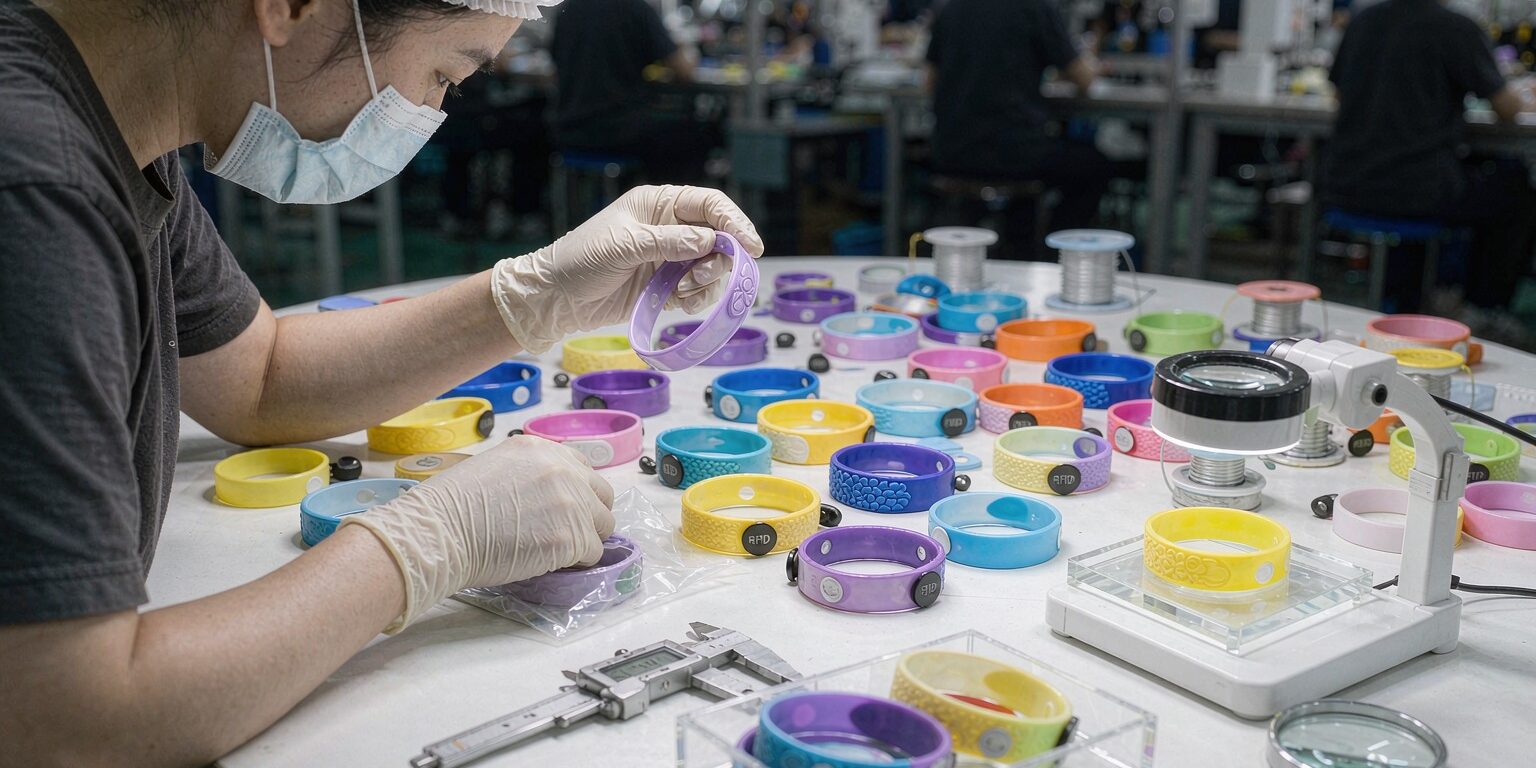
Why Material Choice Matters in Bulk RFID Wristband Sourcing
When buyers compare wholesale RFID wristband options, material is not a cosmetic afterthought. It determines how long a wristband lasts, how comfortable it feels, how well the embedded chip performs, and how efficiently the product ships across borders. A wrong material choice can increase on-site replacement rates, weaken the attendee experience, or inflate total landed cost.
As an experienced RFID wristband manufacturer, SHANGHAI RFIDHY TECH. CO.,LTD helps distributors and event operators specify between two of the most common materials: RFID silicone wristbands und RFID disposable PVC wristbands. This guide compares both options from a manufacturing and procurement perspective.
Silicone vs PVC: Material Comparison at a Glance
| Factor | Silicone RFID Wristbands | PVC RFID Wristbands |
|---|---|---|
| Material feel | Weiche, flexible, skin-friendly | Lightweight, smooth, moderately flexible |
| Typical use cycle | Reusable, multi-day, season pass | Single-use or short-term event |
| Haltbarkeit | High; resistant to water, sweat, stretching | Good for one or two days; less robust |
| Anpassung | Molded logo, embossing, multi-color | Full-color printing, Variable Daten, barcode/QR |
| Unit cost | Higher at low volume; drops with mold amortization | Lower per unit; ideal for high-volume single events |
| Read range | Slightly reduced if thick; depends on inlay tuning | Thin profile allows consistent near-field and UHF performance |
| Schließung | Adjustable clasp or single-use lock | Adhesive or plastic snap |
Silicone RFID Wristbands: The Reusable Workhorse
Silicone wristbands are the preferred choice for premium events, resort access, membership programs, and any application where the wearer keeps the band for several days or longer. The material is soft, waterproof, and resistant to lotions, sweat, and repeated handling. Because it can be molded in multiple colors and surface textures, it also supports high-end branding through embossed or debossed logos.
For bulk RFID programs, silicone units often carry a higher initial unit price because of tooling and raw material cost. Jedoch, the per-event cost decreases when the same band is reused across multiple days or seasonal programs. Buyers should also consider the closure: a reusable clasp adds cost but improves the customer experience for multi-day access.
PVC RFID Wristbands: The Cost-Effective Disposable Option
PVC wristbands are thin, lightweight, and designed for single-use or short-duration access control. They are frequently used at concerts, feste, Wasserparks, and one-day exhibitions where volume is high and the band does not need to survive beyond the event. The smooth surface is ideal for full-color printing, making PVC a strong candidate for sponsor branding and on-site variable data such as barcodes or QR codes.
From a manufacturing standpoint, other rigid plastic formats share similar lamination and die-cutting processes, but PVC specifically offers a balance of printability and low unit cost. It is important to specify whether the chip must be overmolded or inserted in a laminated pocket, because this affects both durability and read performance.
Chip and Frequency Selection Across Both Materials
Material choice is only half of the specification. The embedded RFID inlays determine frequency, read range, and memory. For most wristband applications, high-frequency (Hf) NFC chips are used because they interact with smartphones for cashless payments, social media check-ins, and access validation. UHF inlays are also available for longer read distances at vehicle gates or in high-throughput entry lanes.
When comparing silicone and PVC, a thin PVC body often makes it easier to achieve consistent UHF or HF performance, because the inlay sits close to the reader antenna with minimal material interference. Silicone can still perform well, but the inlay placement and the thickness of the overmolded area should be validated during prototyping.
If your project spans multiple frequency requirements, ask the manufacturer for a frequency comparison report rather than assuming all wristbands behave the same. A trusted RFID wristband manufacturer will provide traceable chip source documentation and test read ranges on finished samples, not only on bare inlays.
Haltbarkeit, Comfort, and Use Environment
For outdoor events with water exposure, silicone generally outperforms PVC because it does not wrinkle, peel, or loosen when wet. PVC is acceptable for indoor or controlled access scenarios, but prolonged contact with water, sunscreen, or high friction may degrade the adhesive or lamination. Distributors serving water parks, beach clubs, or multi-day camping festivals should therefore guide clients toward silicone or a reinforced PVC structure.
Comfort also matters for compliance. A rough or stiff band leads to removal, which reduces the value of the RFID system. Silicone provides a softer, more forgiving fit for children and long wear times, while PVC’s thin profile is often perceived as more discreet.
Application-Based Recommendations
Different use cases favor different materials. The following list summarizes common sourcing scenarios:
- Single-day festivals and concerts: PVC is often the most cost-effective choice when volume exceeds 10,000 units and the wristband is not re-used.
- Multi-day festivals, camping, or resort access: Silicone is preferred if re-entry and water resistance are required.
- Water parks and beach clubs: Silicone withstands pool chemicals and salt water better than standard PVC.
- Membership and season pass programs: Silicone offers the durability and premium feel needed for repeated wear over weeks or months.
- Corporate events and VIP lounges: PVC supports full-color sponsor printing at lower unit cost, while silicone can be reserved for VIP tiers.
For event-specific planning, see our multi-day festival RFID wristband guide und concert RFID wristbands operations guide.
Wholesale Pricing, Tooling, and Lead Time
Wholesale RFID wristband pricing depends on material, chip type, printing or molding process, closure, and order quantity. PVC wristbands typically have lower tooling investment because they are sheet-fed and printed; silicone wristbands require a mold for embossed or debossed designs, which adds upfront cost but enables a durable 3D texture.
Bulk RFID buyers should compare total landed cost instead of the unit price alone. A lightweight PVC shipment will usually cost less per thousand pieces to ship than a heavier silicone equivalent. Jedoch, if the silicone band replaces two or three daily PVC bands, the total program cost may favor silicone. Working with one manufacturer for both materials can simplify quality control, color matching, and chip sourcing.
Vetting an RFID Wristband Manufacturer in China
When sourcing from a manufacturing hub, look for documented in-house processes: chip bonding, lamination or molding, Drucken, encoding, and quality inspection. Ask for samples with the exact chip and closure you plan to deploy, and request a pre-production sample before committing to bulk volume.
A trustworthy supplier should also provide:
- Material and ROHS/REACH compliance documentation
- Chip sourcing and encoding capability for HF, Nfc, and UHF protocols
- Custom packaging and drop-shipping support
- Clear lead time and tooling costs before order confirmation
Five Questions to Ask Before Your Bulk Order
Before you request a quote, define the following:
- Expected wear duration: one day, three days, or season-long?
- Reader distance and environment: near-field smartphone tap or long-range UHF gate?
- Closure type: adjustable for multi-day comfort or single-use locking for security?
- Printing or molding requirements: full-color variable data, embossed logo, or both?
- Order quantity and shipment target: enough to amortize tooling and meet event date?
Having these answers ready will shorten the sampling and quotation cycle with an RFID wristband manufacturer.
FAQ
What is the main difference between silicone and PVC RFID wristbands?
Silicone is soft, reusable, and highly durable, making it suitable for multi-day access and membership use. PVC is thinner, lower cost per unit, and designed primarily for single-use or short-duration events. The choice depends on wear duration, environment, and total program budget.
Which material is better for outdoor or water-intensive events?
Silicone generally performs better in wet, high-friction environments because it resists water, sunscreen, and stretching. Standard PVC can work indoors or for short outdoor use, but may degrade with prolonged water or chemical exposure.
Can I get custom branding and variable data on both materials?
Ja. Silicone supports embossed or debossed logos and multi-color molding. PVC supports full-color printing, barcodes, QR codes, and sequential numbering, making it a good option for sponsorship branding and on-site variable data.
What chip options are available for bulk RFID wristbands?
Common options include high-frequency NFC chips for smartphone interaction and UHF chips for longer-range entry or tracking. The inlay is embedded inside the wristband and should be specified at the sampling stage.
How can I ensure consistent quality when sourcing from China?
Request samples with the exact chip, closure, and printing you plan to deploy. Ask for compliance documentation, encoding capability, and a pre-production sample before bulk shipment. Working with a single manufacturer for both silicone and PVC can simplify quality control.
Request a Bulk Wristband Quote
Whether you need silicone for multi-day access or PVC for high-volume single-use events, we can help you specify the right chip, closure, and printing at a competitive landed cost.
Contact our bulk inquiry team to start your order.