
What Is a UHF RFID Wristband?
A UHF RFID wristband is a wearable credential containing a passive ultra-high frequency RFID chip and antenna tuned to the 860–960 MHz band. The tag remains passive, meaning it does not need a battery; it draws power from the reader signal and returns its unique identifier. In open environments, UHF RFID wristbands can be read from several meters away—commonly 3 Para 10 meters depending on the chip, antenna design, reader power, and surrounding materials. This capability supports fast chokepoint validation and high-volume scanning without line-of-sight aiming.
How Long-Range RFID Scanning Works
In a typical long-range RFID setup, un fixed UHF RFID reader or a handheld RFID scanner sends an RF signal through one or more RFID antennas. When a wristband enters the read field, its chip modulates the signal and returns the identifier. The reader decodes multiple tag responses in rapid sequence using UHF Gen2 anti-collision protocols. This is the foundation of bulk RFID scanning: instead of reading one barcode at a time, the system can capture dozens of wristbands in a single gate transaction.
UHF wristbands operate as part of the RAIN RFID ecosystem, which standardizes communication between tags and readers. Because the protocol supports many tags in the same field, it is well suited to crowded entry lanes and dense pallet staging areas.
UHF vs. HF/NFC in Wearable Credentials
UHF differs from HF/NFC systems in read range and anti-collision performance. NFC-based systems typically require near-field contact or very close proximity. UHF-based credentials prioritize distance and bulk reads, which is why they are favored for festival gates, vehicle lanes, and warehouse zone checkpoints. Sin embargo, UHF is more sensitive to metal and liquids, so deployment planning matters. For a detailed comparison, see our guide on HF-NFC vs UHF RFID Wristbands.
UHF Event Access Control in Practice
At multi-day festivals, sporting events, and large conferences, gates must process tens of thousands of attendees within short windows. UHF event access control uses fixed readers at entry lanes and handheld readers at satellite checkpoints. Staff can validate credentials without physical contact, line-of-sight aiming, or manual barcode scanning. The result is faster throughput, fewer missed scans, and more reliable tiered access management.
For large-scale event planning, see our article on Multi-Day Festival RFID Wristband Strategy.
Common Event Use Cases
- Entry and re-entry: Credentials are read at main gates and secondary entry points, allowing re-entry without paper stamps or manual checks.
- Tiered access: VIP, artist, crew, and general admission zones can be enforced by encoding different access profiles on the same wearable.
- Cashless payments: A wristband can link to a prepaid account at point-of-sale terminals, reducing transaction time and cash handling.
- Session tracking: Conference organizers can log session entry for attendance and capacity control.
Bulk RFID Scanning at Festival Gates
Because UHF tags support anti-collision protocols, a fixed reader at a gate can capture multiple wristbands in near-real time. This is particularly useful at wide entry lanes where attendees walk through in groups. System designers may combine floor-mounted antennas with overhead readers to create a three-dimensional read zone, reducing missed tags and optimizing read reliability. Bulk RFID scanning also supports vehicle checkpoints for camping or backstage access, where a handheld unit can scan a shuttle of passengers without requiring every person to exit.
Warehouse and Logistics Applications
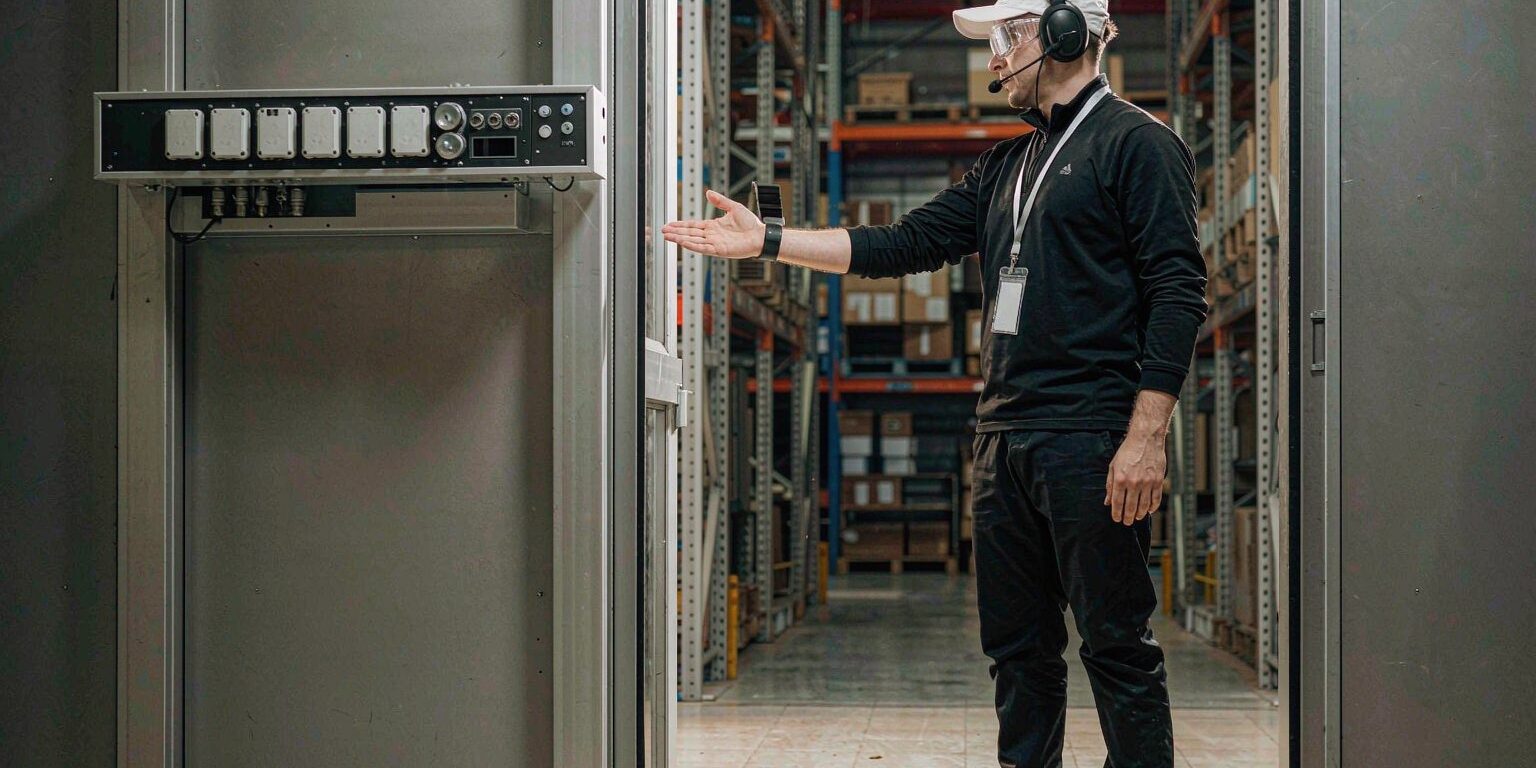
UHF RFID wristbands are not limited to events. In warehouse and logistics environments, they can serve as hands-free staff credentials for equipment operation, zone access, and picking confirmation. When combined with UHF RFID tags on pallets, totes, o activos, the same fixed reader infrastructure can support staff identification and asset tracking simultaneously.
Warehouse UHF RFID Wristband Scenarios
- Forklift operator authentication: A wristband allows authorized operators to start a vehicle and logs which employee used the asset.
- Zone-based access: Staff can be granted access to specific storage areas, docks, or high-value inventory zones without carrying key cards.
- Picking and packing confirmation: The wristband ties an employee to a picking session, while tags on bins or orders confirm the right item was pulled.
- Safety and evacuation: Long-range readers at muster points can account for personnel during an emergency without delaying evacuation.
Event vs. Warehouse: Planning Differences
| Factor | Events | Warehouses |
|---|---|---|
| Primary goal | Fast attendee throughput, access tiers, cashless | Staff identification, asset visibility, zone control |
| Read environment | Open gates, temporary infrastructure, high density | Metal racks, concrete, moving equipment, RF noise |
| Typical reader mix | Fixed readers at gates, handhelds at re-entry | Portal readers, forklift-mounted readers, fixed dock readers |
| Wristband material | Single-use or lightweight formats for short events | Durable formats for repeated industrial use |
| Integration priority | POS, control de acceso, CRM | WMS, ERP, safety and access systems |
Reader Infrastructure for Long-Range RFID
A reliable long-range RFID system is more than a chip inside a wristband. The reader network must generate consistent read zones that cover the intended passage without excessive overshoot. Fixed reader installations often use multiple antennas to create a three-dimensional field, while handheld units provide flexibility for parking lots, remote docks, or contingency entry points. Reader power, antenna gain, cable loss, and tag sensitivity all interact; a higher power setting does not always improve accuracy and may create phantom reads from adjacent areas.
Pilot Testing Before Full Deployment
Before committing to thousands of wristbands, run a pilot with 50 Para 100 units. Test different placements—left wrist, right wrist, over a sleeve—and record read performance at realistic walking speeds. In warehouses, test near metal racking, rolling carts, and dock doors. In events, test in the actual gate with the same reader hardware and crowd density. Pilots help identify dead zones, reader crosstalk, and integration gaps before the live environment exposes them.
Choosing the Right UHF RFID Wristband
Not every UHF wristband performs the same. The choice of chip and UHF RFID inlays determines read sensitivity, memory, and encoding speed. Material choice matters as well: single-use formats work for one-day events, while more durable formats suit multi-day festivals and industrial staff use. Ensure the closure cannot be transferred between users; tamper-evident or single-use closures are critical for access control and inventory accuracy.
Key Selection Criteria
- Read range: Match the chip and antenna design to the longest gate or dock distance in your deployment.
- Memory: Confirm the chip has enough EPC and user memory for your access profile or employee ID scheme.
- Durabilidad: For multi-day or industrial use, choose abrasion-resistant materials and secure closures.
- Encoding workflow: Make sure the wristbands can be pre-encoded or encoded on-site with your existing reader infrastructure.
- Environment: Metal racks and RF-dense equipment require on-site testing before full rollout.
Security and Data Considerations
UHF wristbands are passive credentials, not GPS trackers. They transmit only when energized by a reader, and they should not be treated as real-time location tools across a facility. For staff or attendee data, configure readers to capture only the minimum necessary identifiers, and use encrypted data links between readers and the backend. If access tiers are encoded in user memory, apply appropriate read/write passwords to prevent unauthorized modification.
Sustainability in High-Volume Wristband Programs
Large events and logistics deployments can consume thousands of wristbands per season. Teams seeking to reduce waste can evaluate biodegradable or recyclable materials for single-use credentials, or durable options for repeated staff use. Our guide to sustainable RFID wristbands outlines material choices and trade-offs.
Conclusión
UHF RFID wristbands solve a fundamental operational problem: capturing many identities quickly and reliably without line-of-sight scanning. For event teams, they unlock faster gates, tiered access, and cashless transactions. For warehouse managers, they connect staff movement to asset and inventory workflows using the same reader infrastructure. The key is matching the wearable material, chip, reader, and integration layer to the real environment—then testing before the first attendee or shift arrives.
Frequently Asked Questions
How far can a UHF RFID wristband be read?
In open environments, UHF RFID wristbands are commonly read from 3 Para 10 metros. Actual range depends on the chip, antenna design, reader power, and surroundings such as metal racks or crowd density. A pilot test is the most reliable way to confirm performance on site.
Can UHF RFID wristbands be scanned in bulk?
Sí. UHF Gen2 anti-collision protocols allow a reader to capture many tags in rapid succession. This makes bulk reading practical at festival gates, warehouse portals, and vehicle checkpoints where several people pass through simultaneously.
Are UHF RFID wristbands safe to wear?
UHF RFID wristbands are passive devices that use non-ionizing radio waves and only respond when energized by a reader. They do not continuously transmit and are widely used in event and workplace access applications.
What is the difference between UHF and HF/NFC wristbands?
UHF wristbands are designed for longer read range and bulk scanning, making them suitable for gates, docks, and zone access. HF/NFC credentials operate at shorter range and are often used for tap-to-connect interactions and phone compatibility.
Can UHF RFID wristbands support cashless payments?
Sí. The wristband carries a unique identifier that can be linked to a prepaid or tokenized payment account. Point-of-sale systems read the wristband and authorize the transaction, reducing cash handling and speeding up concessions.
Plan Your Long-Range RFID Wristband Deployment
RFIDHY supports B2B teams with UHF wearables, reader hardware, and integration guidance for events, warehouses, and access control projects. Speak with our team to evaluate materials, patatas fritas, and pilot hardware for your site.