
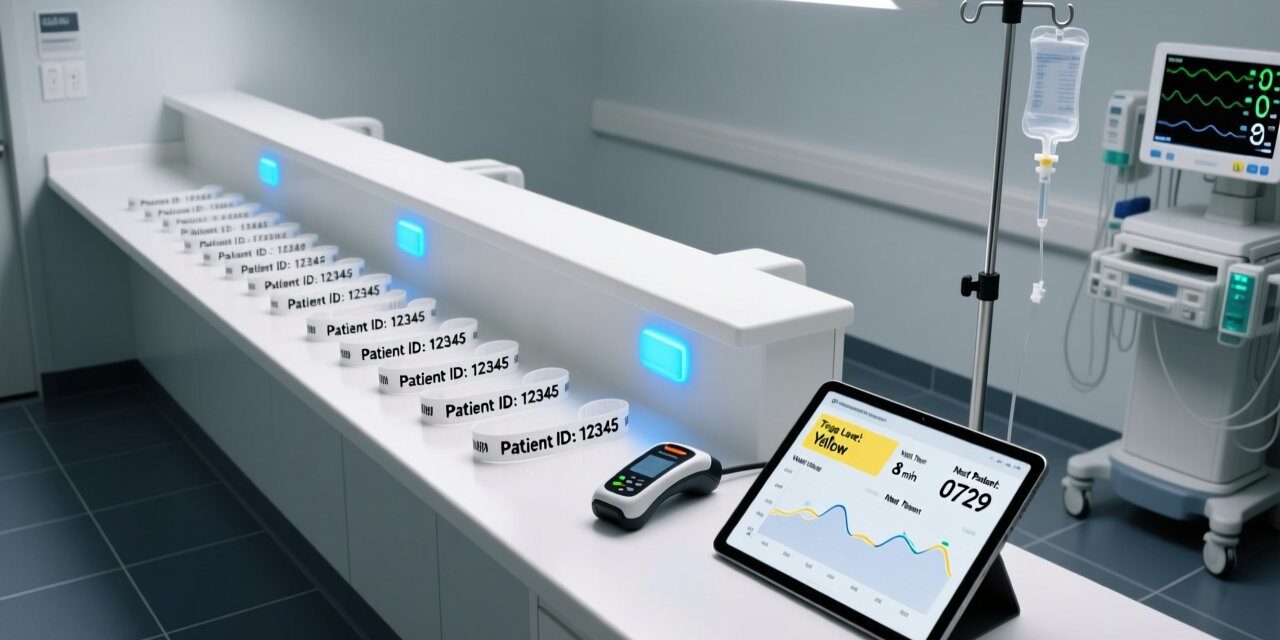
Why Disposable RFID Wristbands Are Critical for U.S. Emergency Departments
In high-acuity, high-volume emergency rooms across the United States, patient identification errors remain a persistent safety risk—and a leading contributor to adverse events. According to The Joint Commission, misidentification accounts for over 15% of sentinel events in acute care settings. Traditional barcode or handwritten wristbands lack real-time verification, are prone to smudging or removal, and offer no inherent anti-switching protection. Bracelets en papier jetables RFID et Bracelets jetables en PVC RFID address these gaps with contactless, encrypted, one-time-use identification that integrates seamlessly into existing registration and EHR workflows.
Vitesse: Reducing Triage Time Without Compromising Verification
ER throughput hinges on rapid, reliable patient onboarding. Scanning a single-use RFID wristband takes under 0.5 seconds—even through gloves or at a distance of up to 30 cm—compared to line-of-sight barcode scanning requiring precise alignment and lighting. This enables simultaneous batch scanning during mass-casualty intake and eliminates re-scans due to smudged or torn labels. Clinical pilots in Midwest Level II trauma centers reported a 22% reduction in average registration-to-triage handoff time when deploying Bracelets ABS jetables RFID, with zero misreads across 12,000+ Scans.
Précision: Preventing Misidentification at the Point of Care
Unlike static barcodes, passive RFID chips store unique, non-clonable UID data and support read/write functionality for dynamic updates (par ex., allergy flags, isolation status, or lab result links). When paired with HIPAA-compliant middleware, these bracelets RFID d'hôpital enable closed-loop medication administration, vérification des transfusions sanguines, and automated vitals logging—reducing manual transcription errors. FDA-cleared Bracelets thermiques RFID further extend utility by supporting on-device printing of patient-specific identifiers post-registration.
Cost Per Patient: A Transparent Total-Cost Analysis
Procurement teams often compare unit price alone—but true cost includes labor, waste, and error remediation. UN 2023 benchmark study across 18 NOUS. community hospitals found that printable medical wristband RFID solutions reduced per-patient ID-related labor by $1.42 (based on RN wage rates and time saved), cut supply waste by 37% (contre. reusable bands requiring cleaning/reprocessing), and lowered incident-related costs by an estimated $28.60 per avoided near-miss. With bulk pricing starting at $0.18/unit for Bracelets jetables en PVC RFID, the ROI becomes measurable within three months.
Guide de sélection des produits de bracelets pour les États-Unis. ER Procurement
| Cas d'utilisation | Recommended Product | Principales fonctionnalités | Integration Notes |
|---|---|---|---|
| High-volume, low-acuity intake (par ex., urgent care wings) | Bracelets en papier jetables RFID | Low-cost, eco-friendly, thermal-print compatible | Works with Zebra ZD420 and Honeywell PC42t printers; supports HL7 ADT feeds |
| Longer-stay observation or behavioral health units | Bracelets jetables en PVC RFID | Résistant à l'eau, inviolable, 3–5 day wear life | Compatible with Epic Rover and Cerner Soarian via standard RFID middleware |
| Pediatric or sensitive-skin populations | Bracelets ABS jetables RFID | Hypoallergenic, flexible, sans latex, pediatric sizing | Pre-configured for integration with McKesson Paragon and Meditech Expanse |
FAQ
- Are disposable RFID wristbands compliant with CMS Conditions of Participation?
Oui. Tous Bracelets RFID pour la santé meet ASTM F2971-21 standards for patient identification devices and support NIST SP 800-53 controls for data integrity. - Can these wristbands integrate with our existing EHR without custom coding?
RFIDHY provides pre-certified middleware connectors for Epic, Cerner, Meditech, and Allscripts—enabling plug-and-play HL7 v2.x and FHIR R4 ingestion with no internal IT development required. - Do you offer HIPAA Business Associate Agreements (BAAs)?
Oui. BAAs are available upon request for all hospital and distributor partners purchasing disposable RFID wristband ER solutions. - What’s the minimum order quantity for U.S. hospital distribution?
We support tiered MOQs: 2000 units for pilot evaluation, 5,000 units for regional rollouts, and blanket PO programs for national GPOs and IDN distributors.
Ready to pilot disposable RFID wristbands in your emergency department? Contact our U.S. Healthcare Solutions Team for a no-cost workflow assessment, trousse d'échantillons, and customized cost-per-patient projection based on your facility’s volume and EHR environment.