
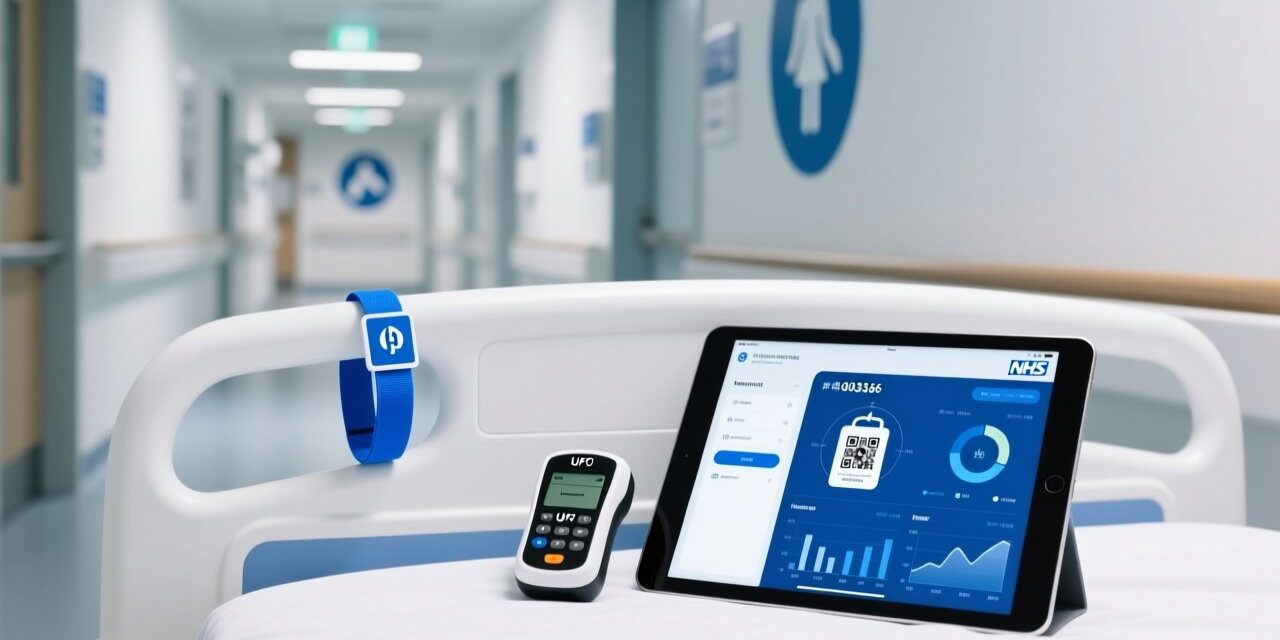
Meeting NHS Procurement Standards for Patient Identification
For NHS procurement departments, selecting compliant, secure, and interoperable patient identification solutions is non-negotiable. RFID patient wristbands must align with NHS Digital’s Data Security and Protection Toolkit (DSPT), ISO/IEC 15408 (EAL4+) for secure element validation, and BS EN 16931 for electronic invoicing readiness. Crucially, all RFID components must support NHS Smartcard-compatible authentication protocols and integrate with existing PAS (Patient Administration Systems) and EPR (Electronic Patient Record) platforms such as Epic, Cerner, and TPP SystmOne.
Código de barras + RFID Dual-Technology: Ensuring Backward Compatibility
Many NHS trusts maintain legacy barcode scanners across wards, labs, and pharmacies. To avoid costly infrastructure overhauls, dual-technology wristbands — embedding both a GS1-compliant 128 barcode and an ISO 15693 or ISO 18000-6C (UHF) RFID chip — deliver seamless transition paths. These hybrid wristbands allow phased adoption: staff scan barcodes today while preparing backend systems for full RFID workflow automation tomorrow. RFIDHY offers RFID disposable ABS wristbands with integrated thermal-printed barcodes and embedded UHF inlays, validated for clinical durability and EMR sync reliability.
Cost Efficiency Beyond Initial Unit Price
True cost efficiency lies in total cost of ownership (TCO), not per-unit sticker price. Reusable RFID wristbands reduce annual consumables spend by up to 65% versus disposable paper alternatives. When paired with RFID reader modules supporting bulk read (hasta 50+ etiquetas/seg), nursing staff save critical minutes per shift during admissions, medication verification, and discharge checks. Automated audit trails also lower compliance reporting overhead and reduce manual error correction costs — a key factor for NHS trusts operating under stringent CQC inspection frameworks.
Material Compliance & Clinical Safety
All wristbands supplied to NHS facilities must comply with UKCA/CE marking for medical devices (Class I), ISO 10993-5 cytotoxicity testing, and latex-free, hypoallergenic construction. RFIDHY’s RFID silicone wristbands are manufactured under ISO 13485-certified processes and tested for MRI safety (ASTM F2503), making them suitable for radiology, oncology, and neonatal units where electromagnetic interference is a concern.
Selecting a Trusted Hospital Wristband Supplier
A qualified hospital wristband supplier must demonstrate proven NHS engagement, UK-based logistics, GDPR-compliant data handling, and end-to-end traceability from chip sourcing to final packaging. RFIDHY maintains dedicated UK distribution channels and offers batch-level serialization, printable QR/barcode overlays, and optional NFC-enabled variants for patient-facing self-service kiosks. Our RFID wristbands for healthcare portfolio includes LF, HF, and UHF options — each pre-tested with leading UK hospital middleware providers including Orion Health and DXC Technology.
Frequently Asked Questions
- Do RFID patient wristbands interfere with medical equipment?
When using LF (125 Khz) or HF (13.56 MHz) frequencies and properly shielded UHF inlays, interference is negligible. All RFIDHY healthcare wristbands undergo EMC testing per IEC 60601-1-2. - Can existing NHS barcode scanners read dual-tech wristbands?
Yes — the GS1-128 barcode remains fully scannable with any standard 2D imager. The RFID layer operates independently via compatible readers. - Are RFID wristbands reusable across multiple admissions?
Reusable models like our RFID silicone wristbands support >500 cleaning cycles and retain data integrity after autoclave simulation (121°C, 20 min). - What data security measures apply to RFID patient data?
Data resides exclusively on the wristband’s secure element; no PII is stored on readers or cloud platforms unless explicitly configured within NHS-approved architecture.
Ready to Streamline NHS Patient Identification?
Request your complimentary NHS procurement compliance checklist and sample dual-technology wristband kit — tailored for UK trusts.