
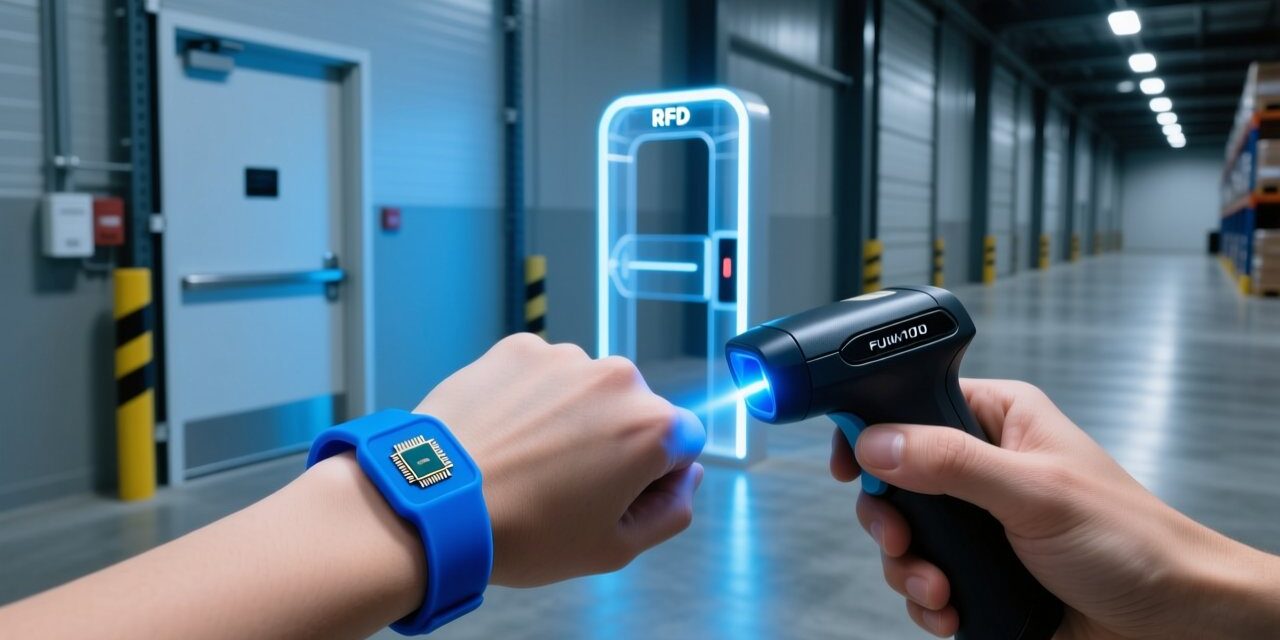
Why RFID Frequency Selection Is Critical for Wristband Projects
When engineering an RFID wristband solution, the chip frequency is not a trivial checkbox — it defines read range, data throughput, resistance to interference, and compatibility with existing infrastructure. For system integrators and OEM decision-makers, choosing between LF (125 kHz), HF (13.56 MHz), UHF (860–960 MHz), and NFC (13.56 MHz subset) requires balancing physics, standards, and application-specific demands. A wristband designed for livestock must operate reliably near metal and fluids, while a festival entry token must deliver millisecond reads with smartphone interaction. This guide breaks down each frequency’s technical profile, links chip families like MIFARE DESFire and NTAG213 to real-world use cases, and provides a decision matrix to streamline your chip selection.
RFID Frequency Fundamentals: LF, HF, UHF, and NFC
All RFID systems use electromagnetic fields to transfer data, but the operating frequency determines how energy propagates, how tags are designed, and which standards govern communication. The table below summarizes the core parameters before we dive into each band:
| Frequency Band | Typical Chip | Read Range | Key ISO Standards | Primary Applications |
|---|---|---|---|---|
| LF (125 kHz) | EM4102, ATA5577 | < 10 cm | ISO 11784/85 | Animal tracking, access control |
| HF (13.56 MHz) | MIFARE Classic, MIFARE DESFire, ICODE SLIX | 2–10 cm | ISO 14443A, ISO 15693 | Payment, ID, ticketing, data transfer |
| UHF (860–960 MHz) | Impinj Monza, Alien Higgs | Up to 10 m | ISO 18000-6C (EPC Gen2) | Inventory, logistics, long‑range scanning |
| NFC (13.56 MHz) | NTAG213, ST25TA, MIFARE DESFire EV3 | 2–10 cm (tap‑to‑read) | ISO 14443A, NFC Forum Type 2/4/5 | Smartphone interaction, anti‑counterfeiting, consumer engagement |
Low Frequency (LF) 125 kHz: Robust Short‑Range Identification
LF RFID operates at 125 kHz to 134 kHz, using inductive coupling to energize passive tags. The physics limits read distance to under 10 centimeters, making it ideal for applications where a scanner must be brought directly to the tag. Because low‑frequency signals penetrate water, tissue, and non‑ferrous metals with minimal attenuation, LF is the workhorse for animal tracking and animal RFID tag systems. Ear tags, glass‑tube injectable transponders, and cattle boluses all employ LF chips complying with ISO 11784/85.
In wristband format, LF is rarely used for consumer wearables but finds a secure niche in access control. Prisoner ID bands, industrial safety wristlets, and some military accreditation systems rely on LF because the short read range prevents skimming and the signal is unaffected by the human body’s dielectric properties. Chips like EM Microelectronic’s EM4102 offer unique factory‑programmed serial numbers, while ATA5577 allows write‑once memory for storing a few bytes. Data rates are low (typically 4–8 kbps), but that is sufficient for a simple ID.
Integration considerations: LF readers are cost‑effective but cannot process multiple tags simultaneously. For projects requiring bulk scanning, HF or UHF becomes mandatory.
High Frequency (HF) 13.56 MHz: The Versatile Workhorse for Payments and Events
HF RFID is the most balanced frequency for wristband deployments, offering read ranges of 2–10 centimeters, moderate data speeds up to 848 kbps, and a mature ecosystem of standards and chips. The 13.56 MHz band supports two major ISO protocols: ISO 14443A for proximity cards with encryption (e.g., payment, transport) and ISO 15693 for vicinity cards with longer range and simpler memory structure (e.g., library books, industrial pallets).
For wristbands, the chip family choice dictates functionality:
- MIFARE Classic / MIFARE Plus – widely used in access control and closed‑loop payment. The Classic variant uses a proprietary CRYPTO1 security algorithm; Plus upgrades to AES‑128.
- MIFARE DESFire EV2/EV3 – a multi‑application chip that can host several independent virtual cards on one wristband. Organisers use DESFire to combine door access, cashless payment, and loyalty points on a single HF RFID inlay. It supports AES, 3DES, and ISO 7816‑4 APDU commands, making it compatible with existing transit and banking infrastructures.
- ICODE SLIX – an ISO 15693 chip popular in library and document tracking, but also used in wristbands where a larger read range (up to 1.5 m with a gate antenna) and simple anti‑collision are needed.
HF wristbands dominate event ticketing, hospital patient ID, and hotel key cards. At a music festival, an HF wristband can store a ticket credential, process cashless payments, and unlock VIP areas — all within the same chip. The 2–10 cm read range provides just enough separation between scanner and wearer to maintain throughput while preventing accidental reads from adjacent gates. Anti‑collision algorithms allow reading roughly 30–50 tags per second, suitable for gate entry with pedestrian flow.
NFC (13.56 MHz): The Smartphone‑Compatible Subset
NFC is not a separate frequency; it uses the same 13.56 MHz carrier as HF RFID but adds a standardized protocol stack that enables two‑way communication with smartphones. Any NFC‑enabled Android or iOS device can read a tag or emulate a card, bridging physical wristbands to digital experiences. NTAG213 is the most common chip for NFC wristbands because it is fully NFC Forum Type 2 compliant, offers 144 bytes of user memory, and supports fast read (scanning an NDEF record in under 100 ms).
Key technical distinctions:
- Tap‑to‑read: NFC requires the phone within 2–4 cm of the wristband, similar to contactless payment. This intentional proximity is a feature for security and deliberate user interaction.
- MIFARE DESFire EV3 NFC: NXP’s latest DESFire chip supports both ISO 14443A and NFC Forum Type 4 Tag Operation, allowing a wristband to be read by dedicated readers for high‑security functions (e.g., AES mutual authentication) and by a smartphone for lighter tasks (e.g., retrieving a menu link). This multi‑application capability makes DESFire the go‑to for integrated resort wristbands.
- Memory and encryption: NTAG213 has limited security (password‑protected write), suitable for NTAG213 NFC sticker and consumer engagement where counterfeiting is not a primary threat. For digital product authentication, chips with AES like NTAG424 DNA or ST25TA are better choices.
While NFC wristbands can theoretically work with any HF reader, the real value lies in smartphone interactivity. Use them when you want attendees to tap their wrist to check event schedules, share social media posts, or verify product authenticity. In industrial settings, NFC is less common because the short range and phone‑dependency add friction compared to hands‑free UHF scanning.
Ultra‑High Frequency (UHF) 860–960 MHz: Long‑Range Logistics Power
UHF RFID operates in the 860–960 MHz band (region‑specific: 902–928 MHz in Americas, 865–868 MHz in Europe) and uses backscatter coupling, which enables read ranges of up to 10 meters with passive tags. The EPC Gen2 air interface protocol (standardized as ISO 18000‑6C) supports dense tag populations, fast anti‑collision (up to 1000 tags per second), and a unique ID plus user memory banks.
In wristband form, UHF is almost exclusively used in warehouse logistics, industrial safety, and large‑scale event logistics where you need to track personnel or items without requiring them to stop at a reader. Examples include:
- Workers at a distribution center wear a UHF RFID tags-based wristband that logs their movement through zone gates, enabling real‑time location and automatic safety check‑ins.
- In a marathon, UHF tags on race bibs or wristbands record split times as runners pass mats, achieving 99% read accuracy without slowing them down.
- Supply chain tracking: reusable plastic containers or tools fitted with UHF wristband‑style tags can be inventoried in seconds by walking through a portal.
However, UHF has limitations: signal absorption by the human body (high water content) reduces range when the wristband is worn snugly. Design mitigations include mounting the tag on a spacer to create an air gap, using specialized UHF RFID ABS tags with high sensitivity chips, or employing a hybrid dual‑frequency tag with a separate UHF and HF inlay. Also, UHF readers are more expensive and require careful antenna tuning to avoid stray reads that can mis‑identify individuals in crowded areas.
Chip Selection Framework for System Integrators
To choose the right chip frequency, answer these questions in order:
- Read range: Under 10 cm (LF, HF, NFC) or extended up to 10 m (UHF)?
- Environment: Presence of metal, liquids, or dense tag populations? LF penetrates best; UHF suffers from reflections and absorption.
- Data needs: Simple ID only (LF, simple HF), or multi‑application memory with encryption (MIFARE DESFire)?
- Interoperability: Must the tag work with smartphones (NFC) or existing ISO 14443‑based readers (HF)?
- Throughput: Are hundreds of tags in a reader field at once? UHF excels at bulk scanning.
Application mapping follows naturally:
- LF for animals: Injectable glass tags, ear tags – robust against body tissue and dirt, single‑tag read sufficient.
- HF for events: Wristbands with NFC cards-grade security for cashless payment and access; moderate range for gates.
- UHF for warehouse: Long‑range, high‑speed inventory tracking of personnel or assets in motion.
- NFC for consumer engagement: Tap a wristband with a phone to launch a URL, verify a product, or pair via Bluetooth.
Many projects benefit from a dual‑frequency approach. For instance, a resort wristband could embed an HF MIFARE DESFire chip for door locks and payments, and a companion NFC tag for post‑stay survey links. Work with your tag manufacturer to test inlays on different wristband materials — fabric, silicone, PVC — as the material’s dielectric effect can detune the antenna and reduce read range.
Standards Recap and Future Trends
ISO standards ensure global interoperability. ISO 14443A (used by MIFARE DESFire) specifies the physical characteristics and protocol of proximity cards. ISO 15693 defines vicinity cards with larger read range. ISO 18000‑6C governs UHF passive tags. Always verify which standard your existing reader infrastructure supports before committing to a chip.
Emerging trends include RAIN RFID (UHF) integration with IoT cloud platforms for real‑time dashboards, and the adoption of NFC Type 5 tags (ISO 15693‑based) that offer longer read range while maintaining smartphone compatibility. As factories embrace Industry 4.0, UHF wristbands will increasingly carry sensor data (temperature, humidity) using battery‑assisted passive modes.
Conclusion
Selecting an RFID wristband chip requires precise matching of frequency capabilities to application demands. LF ensures reliable short‑range ID in harsh conditions; HF delivers secure, multi‑application transactions for events and healthcare; UHF provides the range and speed for logistics; and NFC brings the smartphone into the loop for interactive experiences. By applying the frameworks and technical data outlined above, system integrators can confidently specify the right chip — whether that is a simple LF EM4102, a versatile MIFARE DESFire, or a high‑speed UHF Impinj Monza — and avoid costly redesigns later.
FAQ
- What is the main difference between LF, HF, and UHF RFID frequencies?
- LF (125 kHz) operates via inductive coupling with very short range (<10 cm) and excellent penetration through water and metal. HF (13.56 MHz) also uses inductive coupling but supports higher data rates and encryption standards (ISO 14443A, ISO 15693) for payment and ticketing. UHF (860–960 MHz) uses backscatter radiation, reaching up to 10 meters, and is designed for fast bulk scanning in logistics and inventory.
- Can NFC wristbands work with all smartphones?
- NFC wristbands based on NTAG213 or MIFARE DESFire EV2/EV3 are compatible with all modern Android devices and iPhone models (iPhone 7 and later) that support NFC reading. The phone must be within 2–4 cm of the wristband. User apps or the default NFC reader trigger the tag, making it ideal for consumer engagement and authentication.
- Which RFID chip standard is best for event ticketing wristbands?
- MIFARE DESFire (ISO 14443A) is the preferred chip for multi‑application event wristbands because it supports AES encryption, fast transaction speeds, and can host multiple independent applications (ticket, cashless payment, access) on a single chip. For simpler, cost‑sensitive events where only a unique ID is needed, MIFARE Classic or ICODE SLIX are sufficient.
- Why is UHF RFID not used for most wristband payment systems?
- UHF RFID’s long read range (up to 10 m) makes it unsuitable for payment security because it could be read from a distance without user intent. Payment systems rely on close‑coupling (NFC/HF) to ensure deliberate transaction initiation. UHF also lacks the standardized encryption and EMV‑layer present in HF payment chips.
Ready to Select Your RFID Wristband Chip?
Choosing the right frequency and chip is just the beginning. At SHANGHAI RFIDHY TECH. CO.,LTD, we help OEM buyers and system integrators navigate the entire process — from inlay prototyping to large‑volume production. Whether you need LF access bands, HF multi‑application wristbands, or UHF logistics tags, our engineering team can match the optimal chip with the ideal wristband material and form factor.
Contact our specialists to discuss your requirements, or browse our wristband collection to see ready‑to‑customize RFID solutions.