
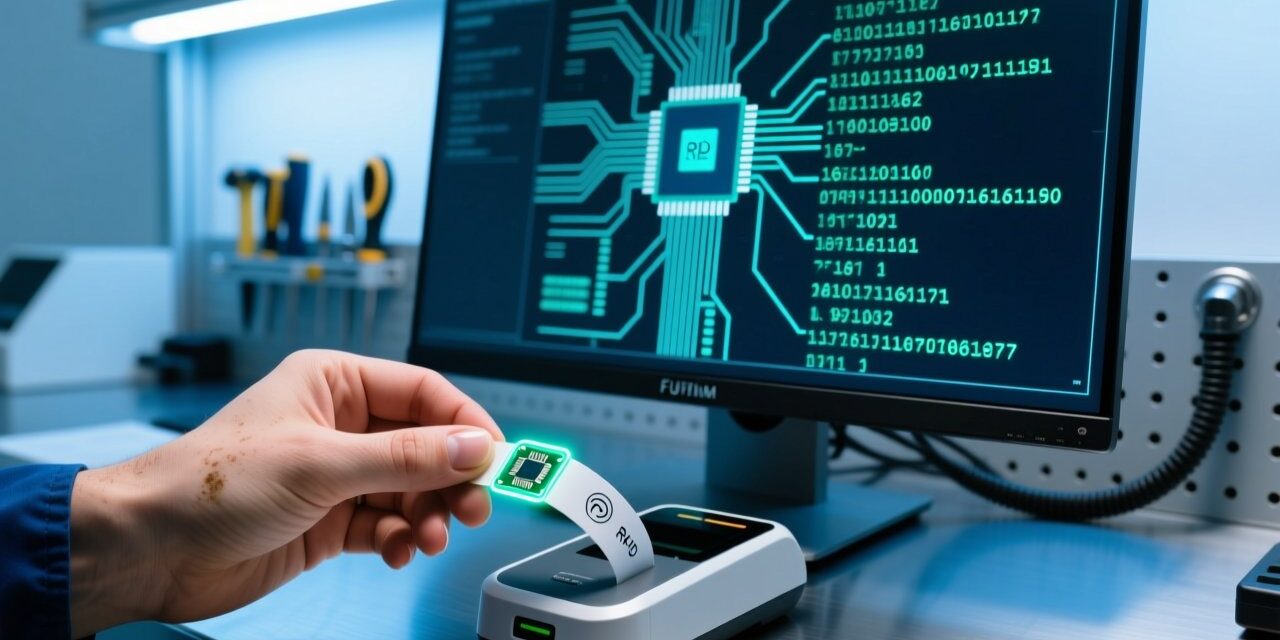
Introduction to RFID Wristband Encoding
For system integrators and OEM buyers, the value of an RFID wristband lies not just in the physical hardware but in the digital identity encoded onto its chip. Proper encoding ensures seamless integration with existing access control panels, cashless payment terminals, and attendance management systems. Whether you are deploying thousands of wristbands for a music festival or a hospital patient tracking solution, understanding chip memory architecture and data programming is critical to avoid read failures and compatibility issues.
This guide walks you through the core concepts of RFID wristband encoding, from the immutable UID and user-defined serial numbers to chip-specific memory layouts and data formats. You will also learn about pre-encoding services that can save your integration team days of effort.
UID: The Factory-Locked Unique Identifier
Every ISO 14443 or ISO 15693 compliant RFID chip contains a UID (Unique Identifier) that is laser-programmed during manufacturing and cannot be altered. For most high-frequency (HF) chips used in wristbands, the UID is either 4 bytes (single size), 7 bytes (double size), or 10 bytes (triple size), depending on the chip type. For example, a standard MIFARE Classic 1K provides a 4-byte UID, while many NTAG213 chips offer a 7-byte UID.
Because the UID is read-only and globally unique, it serves as the foundational identifier in many access control systems. The UID can be extracted automatically by any compliant reader without requiring authentication, making it ideal for simple “swipe to unlock” scenarios. However, relying solely on UID poses a security risk because it can be cloned with readily available devices. For higher security applications, the UID is often combined with a second factor such as a user-programmable serial number or encrypted sector authentication.
When ordering RFID silicone wristbands or fabric wristbands, you can request a UID list from the manufacturer to pre-register each wristband in your database before shipment.
Serial Numbers: User-Programmable Identification
Unlike the UID, a serial number RFID tag can include a programmable numeric identifier usually 7 to 10 digits long. This serial number is written to a specific memory block on the chip and can be reformatted or updated during the encoding process. Many system integrators prefer a custom serial number scheme because it can embed meaning—for example, a prefix indicating event zone, ticket type, or patient department.
On a MIFARE Classic chip, the serial number is typically stored in the first data block (Block 0 of Sector 0 is reserved for manufacturer data; user data starts at Block 1). For NTAG213, the serial number can be encoded in the first pages of user memory alongside other NDEF records. The serial number can be encoded in pure decimal, hexadecimal, or ASCII formats, depending on what the final reader system expects.
MIFARE Classic Memory Structure: 1KB and 4KB Configuration
MIFARE Classic remains one of the most widely used chips in RFID wristbands for access control and cashless payments. Two variants dominate: MIFARE Classic 1K (1,024 bytes of EEPROM) and MIFARE Classic 4K (4,096 bytes). Each variant organizes memory into sectors and blocks.
| MIFARE Classic Variant | Total Memory | Number of Sectors | Blocks per Sector | Typical Application |
|---|---|---|---|---|
| 1K | 1024 bytes | 16 | 4 (3 data, 1 sector trailer) | Access control, simple ticketing |
| 4K | 4096 bytes | 40 (32 sectors × 4 blocks, 8 sectors × 16 blocks) | 4 or 16 | Multi-application, stored value, loyalty |
Each sector has a sector trailer that stores two 48-bit keys (Key A and Key B) and access bits. The access bits define read/write permissions for each block. To write a serial number or payment value to a MIFARE Classic wristband, the encoding system must first authenticate with the correct key. This structure makes it possible to assign different keys to different sectors, enabling multi-application use—for instance, one sector for event access, another for cashless payment, and a third for loyalty points, all on a single wristband.
MIFARE DESFire: File-Based Architecture and Higher Security
For enterprise-grade security, MIFARE DESFire (EV1, EV2, or EV3) replaces the simple sector/block model with a flexible file system resembling a mini hard drive. DESFire chips are available in 2KB, 4KB, and 8KB memory sizes, with the 8KB variant able to store up to 8,192 bytes across 32 applications.
Each application on a DESFire chip can contain multiple files (Standard Data, Backup Data, Value, Linear Record, or Cyclic Record). Access to every file is governed by 14 dedicated authentication keys (up to 16 on EV2/EV3) supporting Triple DES, AES, or 3K3DES encryption. This architecture is ideal for mixed-use environments such as a corporate campus where the same RFID plastic wristband manages door access, printer authentication, and cafeteria payments simultaneously.
Encoding a DESFire wristband requires a programming device that can create applications, set key settings, and write files. RFIDHY offers pre-encoding for DESFire chips, delivering wristbands ready to authenticate with your existing reader infrastructure.
NTAG213: Compact Memory for NFC Applications
The NTAG213 chip is a popular choice for disposable wristbands used at single-day events or short-term promotions. It features 180 bytes of total user memory organized into 45 pages of 4 bytes each. This space can hold an NDEF record (NFC Forum compliant) containing a URL, a small serial number, or a ticket ID. NTAG213 also includes a 7-byte UID, 32-bit password protection, and an original signature function to prevent cloning—a useful feature when wristbands are sold as memorabilia or used for brand activation.
Since NTAG213 is compatible with all NFC-enabled smartphones, field staff can read or update wristband data without dedicated RFID readers, reducing hardware costs. For encoding at scale, RFIDHY provides NTAG213 wristbands pre-programmed with your URL, serial number format, or encrypted payload.
Data Formats: Wiegand, ASCII, HEX, and Binary
The way encoded data is transmitted from the reader to the controller is just as important as how it is stored on the chip. Four common data formats dominate:
- Wiegand: A widely used interface in access control. Data is output as a binary stream over two wires (DATA0/DATA1). Typical Wiegand formats are 26-bit, 34-bit, or 37-bit, conveying the site code and card number. Many readers extract the serial number from the wristband chip and convert it to a Wiegand format.
- ASCII (American Standard Code for Information Interchange): The encoded number is transmitted as human-readable decimal or hexadecimal characters. For example, a 10-digit serial number might appear as “0019203831”. ASCII format is common in serial RS-232/RS-485 interfaces.
- HEX (Hexadecimal): Data is represented in base-16 format, such as “1A F3 2E 0B”. This is often the native format when dumping raw memory from MIFARE Classic. Some older systems expect the serial number in fixed-length HEX strings.
- Binary: Pure binary output, typically used only in low-level debugging or proprietary protocols.
When placing an order with RFIDHY, you can specify the output format—Wiegand 26-bit, ASCII decimal, or HEX—and the encoding team will write the correct bit patterns into the chip memory.
Read-Only vs Read-Write Chips
Not all RFID wristbands allow re-encoding. Read-only chips such as EM4100/4200 or some low-frequency glass tags have their ID permanently set. Once the wristband leaves the factory, the data cannot be modified. These are suitable for fixed-ID applications like event attendance counting where no user interaction is needed.
Read-write chips—including MIFARE Classic, DESFire, and NTAG—allow data to be updated in the field. For example, cashless payment wristbands must be writable so that a top-up at a POS terminal can increment the stored balance. At the configuration stage, it is critical to define which memory blocks are locked after encoding and which remain updatable to prevent accidental overwrites.
Anti-Collision Protocol for Batch Reading
Scenarios like marathon finish lines or festival entry gates involve multiple wristbands in the reader’s field simultaneously. The ISO 14443-3 anti-collision protocol enables the reader to detect and communicate with each tag individually. When a reader energizes the field, all wristbands respond with their UID at the same time. The reader detects a collision and initiates a binary tree search, progressively narrowing down the UID until only one tag remains active. This process repeats until all tags are inventoried.
Chips like MIFARE Classic and NTAG213 support anti-collision, allowing batch reading of 50+ wristbands per second with a high-performance reader. In access control turnstiles, this capability is less critical because generally only one wristband is presented at a time, but for handheld scanners used to verify guest numbers, anti-collision ensures accurate counts.
Pre-Encoding Service: Streamline Your Deployment
One of the biggest time-sinks for system integrators is on-site RFID chip programming. Manually encoding thousands of wristbands using a desktop USB reader is error-prone and labor-intensive. RFIDHY provides a pre-encoding before shipment service that programs each wristband according to your specification:
- Write a custom serial number range (e.g., 10000001 to 10020000).
- Format data as Wiegand, ASCII, or HEX.
- Set sector keys (Key A/B) for MIFARE Classic.
- Create DESFire applications with authentication keys.
- Encode an NDEF URL on NTAG213.
- Deliver a spreadsheet with UID, serial number, and encoded data for database import.
This service can also include printing a visual ID number or barcode on the wristband that matches the encoded data, providing a reliable fallback if the RFID chip is damaged. By receiving wristbands that are 100% ready to scan, you can cut installation time on site by days.
To discuss your encoding requirements or request a sample, reach out to our team through the contact page. For standard wristband models that can be encoded with your data, browse our online shop.
FAQ
What is the difference between UID and serial number on an RFID wristband?
The UID is a factory-locked, globally unique number hard-coded into the chip that cannot be changed. The serial number is a user-programmable identifier, usually 7–10 digits, that you encode to a memory block on the chip to match your database scheme. Both can be used for identification, but the serial number offers more flexibility for custom formats and integration with legacy access control software.
Can I encode MIFARE Classic and NTAG213 wristbands with the same data?
Yes, the same logical data (e.g., a 10-digit decimal number) can be written to both chip types. However, the encoding commands and memory mapping differ. MIFARE Classic requires sector authentication and block-level access, while NTAG213 uses page-level commands. RFIDHY’s encoding service handles both and ensures the output format (ASCII, HEX, Wiegand) is consistent across chip types.
How does pre-encoding save time compared to on-site programming?
On-site encoding requires an operator to scan each wristband individually with a desktop reader, authenticate, and write data—a process that takes 2–5 seconds per tag. For 10,000 wristbands, that’s a full day’s work. Pre-encoding in our facility uses automated high-speed encoders that program up to 5,000 units per hour and verify each one. Wristbands arrive ready to use, and you receive a digital manifest with all encoded values for instant database import.
What anti-collision features should I expect for event wristbands?
All ISO 14443 Type A chips (MIFARE Classic, DESFire, NTAG) support the mandatory anti-collision protocol. In practice, a good fixed reader can identify 30–50 wristbands per second when multiple bands enter the field. For high-speed chokepoints like festival gates, we recommend pairing wristbands with a reader specifically tuned for batch reading, such as our industrial-grade UHF reader modules.
Is Wiegand still relevant for modern RFID systems?
Yes. Despite its age, Wiegand remains the de facto interface for connecting RFID readers to access control panels. Most commercial door controllers accept Wiegand 26-bit or 34-bit as a standard input. Because Wiegand data is simply a bit stream representing the card number and site code, it can be easily generated from any chip memory during encoding. When you order pre-encoded wristbands, we can output the raw HEX or ASCII data, or directly format it into the Wiegand bit-string your panel expects.
Ready to Order Pre-Encoded RFID Wristbands?
Stop spending hours on manual programming. Whether you need MIFARE Classic, DESFire, or NTAG213 wristbands encoded with custom serial numbers, Wiegand outputs, or NDEF URLs, RFIDHY’s pre-encoding service delivers wristbands that work out of the box.
Request Your Encoding Specification Form or Browse Ready-to-Encode Wristbands
Have a unique integration challenge? Our engineering team is available to review your memory layout, key management scheme, and data format requirements—get in touch today.