
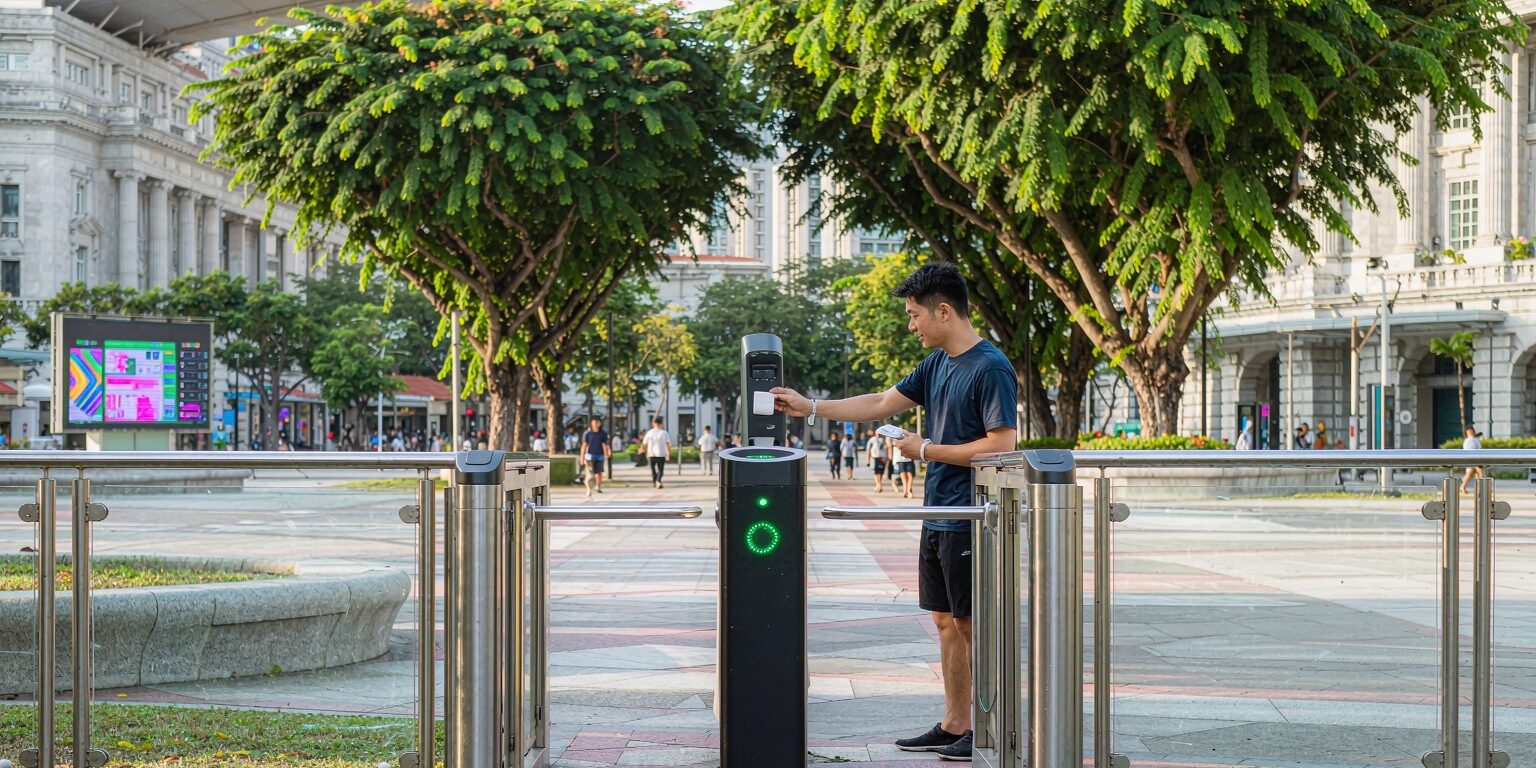
Across Southeast Asia, the conversation around smart city access control is shifting from proprietary cards and PIN pads to wearable, contactless credentials. RFID silicone wristbands are now being evaluated alongside mobile access for government facilities, mixed-use precincts, and resort corridors where speed, durability, and zone-level control matter most.
For project leads in Singapore, Thailand, and Vietnam, the appeal is not the wristband form factor alone. It is the combination of passive UHF or HF read performance, waterproof and tamper-evident construction, and fast integration with existing access management platforms. This guide examines how SEA smart city RFID frameworks are turning wearable credentials into a practical infrastructure layer.
Why SEA Smart City RFID Programs Need a Wearable Access Layer
Urban mobility in Southeast Asia is dense, tropical, and mixed-use. Traditional PVC cards can be forgotten, damaged by humidity, or difficult to manage across multi-operator zones. A wristband stays with the user, reduces card swapping, and supports hands-free movement through turnstiles, lifts, and gated areas. When paired with a robust RFID reader module, the wristband becomes part of a unified access control system that logs entry, exit, and dwell time without requiring line-of-sight scanning.
For government facilities, a wearable credential also simplifies visitor management and emergency accountability. Project teams can combine fixed readers at building entrances with handheld readers at mobile checkpoints, creating a consistent audit trail without redesigning door hardware.
Singapore Access Control: Precision, Density, and Multi-Tenant Trust
Singapore access control projects tend to prioritise interoperability, data privacy, and grade-A building performance. In this context, wearable RFID credentials are being used to support layered access inside commercial towers, data centres, and smart precincts. Because Singapore has clear personal data protection expectations, passive wristbands that store only a unique identifier are often preferred over biometric-only or app-dependent systems. The identifier is verified at the reader and matched centrally, which keeps sensitive data out of the wristband itself.
Government and Commercial Building Access
In multi-tenant government buildings, zone-based permissions can be assigned to different wristband populations: staff, approved visitors, contractors, and emergency responders. Waterproof and tamper-evident wristbands hold up in tropical humidity and daily handwashing, while integrated handheld RFID scanner devices allow security teams to verify identities at lift lobbies or outdoor checkpoints without sending visitors back to a fixed desk.
Smart Precinct and Event Zone Governance
Singapore also uses temporary zones for construction, exhibitions, and public events. RFID fabric woven wristbands provide a comfortable, breathable alternative for multi-day use, while maintaining clear visual differentiation through colour coding and zone printing. This supports temporary access without issuing permanent building credentials.
Thailand Resort Wristband Strategies: Bargeldlosen, Keyless, and Frictionless
Thailand resort wristband programs are no longer limited to festivals or water parks. High-end resorts and integrated hospitality districts are adopting the same wearable credential for room access, cashless payments, and amenity permissions. For project leads, this is a direct extension of smart-city access thinking into the tourism economy. A guest who uses one wristband from check-in to checkout is easier to serve, and the property gains granular data on which zones and services are actually used.
For resort operators, the business case is tightly linked to operational efficiency and guest satisfaction. You can explore our hotel and resort wristband solutions for examples of how these use cases fit a hospitality environment.
Guest Experience and Revenue Integration
A Thailand resort wristband reduces friction at poolside, spa, and F&B outlets. Staff with a handheld scanner can process cashless payments anywhere, even across a beach or garden area where fixed POS terminals are impractical. This roaming capability helps convert more in-resort transactions while preserving a consistent access control and payment log. The same wristband can open room doors, lockers, and staff-only service corridors, reducing the number of separate cards and keys a guest must carry.
Vietnam RFID Deployments: Industrial Parks, Smart Buildings, and Public Services
Vietnam RFID activity often starts with industrial parks, export processing zones, and smart building projects that need to manage large workforces efficiently. In these environments, access control is closely linked to time attendance, contractor management, and zone safety. For one-day visitors or short-duration contractors, RFID disposable paper wristbands offer a low-cost way to maintain auditability without assigning a permanent badge. Once the visit window expires, the credential can be deactivated in software, reducing the risk of lost or reused badges.
For permanent staff, more durable wristband options are often more practical because they withstand industrial conditions and frequent sanitising. The key decision for Vietnam RFID project leads is not whether RFID works, but which frequency and form factor best suit the density of readers, the read distance required, and the existing access control software stack.
Core Smart-City Use Cases for RFID Wristbands in Southeast Asia
- Access control and zone governance: Restrict floors, data centres, plant rooms, and secure corridors using wearable credentials instead of fixed keycards.
- Cashless and transit-linked payments: Link wristbands to stored-value accounts for food courts, parking, micro-mobility, and last-mile transit.
- Workforce and visitor management: Issue temporary wristbands to contractors, remote staff, and event visitors with automatic expiry windows.
- Emergency evacuation and real-time occupancy: Use fixed readers at muster points to reconcile headcounts and identify zones that still contain people.
- Sustainable operations: Reuse durable wristbands for resident or staff populations, while reserving disposable options for short-term visitors.
| Use Case | Recommended RFID Wristband | Key Integration Points |
|---|---|---|
| Singapore office tower access | RFID silicone wristbands | Lift readers, turnstiles, visitor management |
| Thailand resort guest journey | RFID fabric woven wristbands | Room locks, POS, pool gates, spa access |
| Vietnam industrial park workforce | RFID disposable paper wristbands | Gate readers, time attendance, zone access |
Integration Considerations for SEA Smart City Project Leads
Before scaling any SEA smart city RFID pilot, project leads should confirm three integration points. Erste, the wristband chip type and frequency must match the installed reader base. Mixing UHF and HF without a clear gate strategy can create read failures at turnstiles. Second, the access control software needs to support wristband lifecycle management, including issuing, blacklisting, reissuing, and expiry. Dritte, privacy and data residency requirements differ across Singapore, Thailand, and Vietnam, so the architecture should keep personal identifiers in a controlled back end rather than on the wristband itself.
Working with a manufacturing partner that understands RFID inlays, reader integration, and wristband form factors can shorten this learning curve. A reliable RFID reader module reference design allows system integrators to test read range and placement before committing to a full rollout, reducing costly site visits.
Frequency selection is also critical. UHF wristbands support longer read ranges and faster multi-tag reading, which is useful for open gates and vehicle-adjacent walkways. HF or NFC wristbands are often preferred for close-range payment and mobile interaction. Many smart-city programs in Southeast Asia use UHF for zone-level access and HF for tap-to-pay or locker interactions, but a single-frequency approach may be simpler to maintain if the use case is limited.
What to Look for in an SEA Smart City RFID Wristband Partner
- Form factor range: A supplier that offers silicone, Gewebt, disposable paper, and thermal options can support both permanent staff and temporary visitors from a single source.
- Reader and inlay expertise: The partner should provide guidance on chip selection, antenna placement, and reader output so the wristband performs consistently at real-world distances.
- Lifecycle support: Ask about encoding, personalisation, on-site spares, and reissue workflows, not just product unit price.
- Compliance awareness: For Singapore access control and Vietnam RFID projects, the partner should understand data protection expectations and help keep personal data off the credential.
Building a Scalable Roadmap: From Pilot to Citywide Rollout
For government facilities and smart-city project leads, the most effective path is usually a controlled pilot in one building or resort zone, followed by gradual expansion. Start with a single use case such as staff access or contractor visitor management. Measure read reliability, user compliance, and integration effort. Then add cashless payments, amenity access, or emergency mustering only after the base layer is stable. This approach keeps the project credible, avoids overbuilding, and allows SEA smart city RFID programs to scale with evidence rather than assumptions.
Frequently Asked Questions
Are wearable access wristbands secure enough for government building access?
Ja, when implemented correctly. Passive RFID wristbands typically store only a unique identifier. The access decision happens in the back-end system, so a lost or cloned identifier can be blacklisted immediately. Encrypted chips and mutual authentication can be used for higher-security zones.
Which frequency is better for Southeast Asia smart city access control: UHF or HF?
It depends on the read distance and use case. UHF is often better for open gates, zone-level access, and multi-tag reading. HF or NFC is better for close-range payments and mobile interaction. Many pilots use UHF for entry and HF for tap-to-pay lockers or transit.
Can Thailand resort wristbands work in saltwater and high humidity?
Ja. Durable RFID silicone wristbands and sealed woven options are designed for water parks, pools, and tropical outdoor use. Confirm the chip packaging and closure type with the manufacturer before ordering for maritime or chlorine-heavy environments.
How can Vietnam RFID projects manage temporary visitors without issuing expensive badges?
Low-cost disposable or thermal wristbands can be issued to one-day visitors and contractors with automatic expiry. These credentials remain auditable but avoid the cost and recovery burden of permanent badges. They are commonly used at industrial park gates, exhibition halls, and construction site checkpoints.
Plan Your SEA Smart City RFID Deployment
RFIDHY supports government agencies, resort operators, and system integrators across Southeast Asia with RFID wristbands, reader modules, and access control guidance. Whether you are piloting Singapore access control, scaling a Thailand resort wristband program, or planning a Vietnam RFID rollout, our team can help you match frequency, form factor, and integration architecture to your site conditions.