
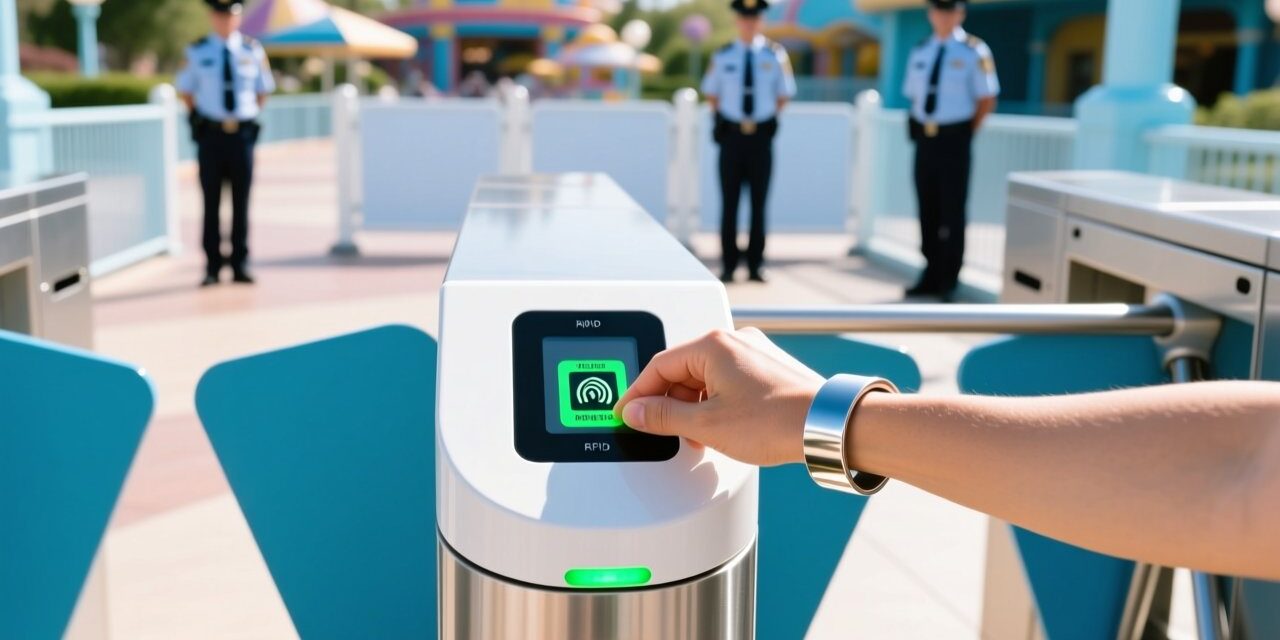
Ticket fraud, gate bypass, and unauthorized access cost theme parks millions each year—not just in lost revenue, but in brand damage and safety vulnerabilities. Traditional paper tickets and barcoded bands are easy to duplicate, alter, or share among multiple guests. As fraud schemes grow more sophisticated, leading parks are turning to RFID wristbands that combine physical security, digital encryption, and real-time network validation to create a virtually impenetrable access control system.
The Hidden Cost of Theme Park Fraud
Before diving into technology, it’s essential to understand the fraud vectors that RFID wristbands are designed to defeat:
- Counterfeit tickets and wristbands: Scammers replicate paper tickets or even barcoded wristbands using commercial printers, then sell them at discounted rates outside park gates.
- Season pass and multi-day pass sharing: Guests share non-transferable long-term passes by physically passing the credential between different users on different days.
- Stolen or found wristbands: Lost or stolen wristbands grant free entry to anyone who picks them up, unless immediately deactivated.
- Gate bypass: Staff members or perimeter breaches allow individuals to enter without scanning, often at secondary employee entrances.
- Internal fraud: Collusion between gate staff and guests can result in intentional undercounting, free entries, or cash-for-admission schemes.
Each of these vulnerabilities can be systematically eliminated by a well-designed RFID wristband solution integrated into a park’s access control network.
How RFID Wristbands Neutralize Ticket Forgery
Factory-Locked Unique ID: The Uncopyable Foundation
Every high-security RFID wristband contains a microchip with a factory-locked unique identification number (UID) that is burned into the chip at the silicon level during manufacturing. This UID cannot be altered, duplicated, or spoofed by any commercially available equipment. When a guest scans their wristband at a gate reader, the system verifies the UID against a central database. If the UID is not present, or if it has already been used within its allowed parameters, access is denied instantly. Unlike barcodes or magnetic stripes, the UID cannot be copied by a smartphone photo or card cloner.
MIFARE DESFire AES Encryption: Military-Grade Anti-Cloning
For parks that require the highest level of security, NFC tags based on MIFARE DESFire EV2/EV3 chips offer AES-128-bit encryption, the same standard used by governments and financial institutions. The mutual authentication process ensures that only an authorized reader can unlock and read the chip’s data, rendering skimming and cloning attempts useless. Even if a fraudster were to capture a radio signal during a scan, the encrypted data stream is meaningless without the secret key. This encryption also enables secure storage of ticket type, validity dates, and stored value—all protected from manipulation.
Tamper-Evident Snap Closure: One-Time Use Only
Physical security is just as critical as digital protection. Single-use RFID wristbands often feature a tamper-evident snap closure that permanently locks when fastened. Any attempt to remove the band—whether by cutting, stretching, or prying open the clasp—results in visible damage or destruction of the antenna circuit, rendering the wristband non-functional. This prevents guests from transferring a band to another person after entry. For reusable wristbands, tamper-resistant mechanisms ensure that removal without a special tool is obvious to security staff.
Holographic Overlay on Vinyl Wristbands
A visual layer of security further frustrates counterfeiters. RFID disposable PVC wristbands can be customized with a holographic overlay—a metallic foil that exhibits shifting patterns under light. This feature is extremely difficult to reproduce without specialized equipment and allows both staff and guests to quickly identify genuine wristbands. Combined with the encrypted chip, the holographic element creates a multi-factor authentication system: something you have (the physical band) and something you know/are (the digital credential).
UV Hidden Print for Staff Visual Verification
For an additional covert layer, security inks visible only under ultraviolet light can be printed on the wristband surface. Staff equipped with inexpensive UV flashlights can instantly verify authenticity without drawing attention or slowing entry lines. These hidden prints might include park logos, batch numbers, or date codes that are invisible under normal lighting, making it nearly impossible for counterfeiters to replicate.
Advanced Anti-Fraud Mechanisms in Gate Control
Real-Time Gate Validation Against Central Database
When a guest scans their wristband at a turnstile, das RFID reader module communicates in real time with the park’s access database over a secure local network. The system checks the UID against allowed entries, blacklists, and validity windows. If all conditions are met, the gate opens. If the band has been reported lost, cancelled, or has already been used for a single-entry ticket, the system triggers an alert and denies entry. This real-time validation eliminates the security gap of offline barcode validation, where a counterfeiter could use a cloned ticket before the database is synchronized.
Blacklist: Immediate Deactivation of Stolen Bands
A critical tool for park security is the ability to instantly add a wristband UID to a network-wide blacklist. If a guest reports their wristband lost or stolen, the administrator deactivates it from any web-connected terminal. Within seconds, that UID becomes invalid at every gate, register, and access point across the entire park. Even if someone finds the physical band, it holds zero value. The blacklist can also be used to revoke privileges for misbehaving guests without physically confiscating the band.
Staff Bypass Prevention: Wristband Logs All Access
Employee entrances are often weak points in park security. By issuing all staff members their own individually tracked RFID silicone wristbands, management can enforce compliance. Every employee scan is logged with a timestamp, creating an audit trail. Any attempt by a staff member to bypass the scanning procedure—whether by holding a door open or using a back entrance—is flagged by the absence of a corresponding log entry. This data-driven approach significantly reduces internal fraud and also aids in time-and-attendance tracking.
Backup Entry: Lost Band Voids Automatically
Guest convenience and security go hand in hand. When a park issues a replacement wristband for a lost one, the old band’s UID is automatically voided in the database as part of the replacement process. The guest receives a new band, and the lost band becomes useless. This mechanism ensures that there is always only one valid credential per paid admission at any given time, closing a major loophole exploited by fraudsters.
RFID Gate Audit Trail: Every Entry Timestamped
Every successful and unsuccessful scan attempt is recorded in a centralized log, including the UID, gate ID, date, time, and result. This audit trail serves multiple purposes: forensic investigation after an incident, monitoring throughput and queue lengths, and identifying patterns indicative of fraud. Zum Beispiel, a single UID repeatedly scanned at different gates within seconds might indicate a cloning attempt, triggering an alert. The historical data also supports compliance and legal evidence if needed.
Comparing Wristband Materials for Anti-Fraud Applications
| Wristband Type | Tamper Resistance | Best Use Case | Visual Security Options |
|---|---|---|---|
| RFID-Silikon-Armbänder | Reusable with locking clasp; detectable removal | Multi-day passes, VIP access, staff bands | Embossed logos, UV print, holographic insert |
| RFID Disposable PVC/Vinyl Wristbands | Tamper-evident snap closure; antenna breaks on stretch | Single-day tickets, Wasserparks, Konzerte | Holographic overlay, UV print, serial numbers |
| RFID-Stoff gewebt Armbänder | Single-use locking slider; visible thread damage if tampered | Multi-day festivals, luxury events | Woven patterns, metallic threads, hidden security fibers |
Implementation Best Practices for Park Security Teams
- Choose the right chip type: For most parks, MIFARE DESFire EV2 offers the best balance of security and cost. Cheaper Ultralight chips lack encryption and are suitable only for very low-risk, one-time use.
- Integrate with existing POS and access systems: The RFID system should not operate in isolation. Link it to point-of-sale terminals so that stolen wristbands cannot make purchases, and to turnstiles and locker systems.
- Train staff on visual inspection: Equip gate attendants with UV flashlights and train them to spot counterfeit holograms. Combine machine verification with human judgment.
- Conduct random spot checks: Use handheld RFID scanners to audit wristbands inside the park. Verify that bands match the current database list and are not known blacklisted items.
- Plan for scalability: The backend database and network infrastructure must handle peak entry times without latency. Real-time validation should not cause delays at the gates.
Conclusion: Proactive Fraud Prevention Protects Revenue and Reputation
Theme park ticket fraud is an evolving threat that demands a multi-layered defense. By deploying RFID wristbands with factory-locked UIDs, strong encryption, physical tamper evidence, and real-time network validation, park operators can close every major fraud vector simultaneously. The system not only stops counterfeiters and gate bypassers but also provides invaluable operational data through detailed audit trails. For parks looking to upgrade their access control, RFIDHY offers a full range of customizable, secure wristband solutions engineered for the unique demands of the entertainment industry.
FAQ
Can RFID wristbands be cloned or copied?
High-security RFID wristbands using MIFARE DESFire EV2 or EV3 chips with AES encryption are practically impossible to clone. The mutual authentication process and secret keys stored in secure hardware prevent skimming and replication.
What happens if a guest tries to remove and share their wristband?
Single-use wristbands incorporate a tamper-evident snap closure that physically breaks or shows clear signs of tampering if removed. Reusable bands often require a special tool for removal and can be designed to log each removal attempt in the database.
How quickly can a lost wristband be deactivated?
Authorized staff can add any wristband UID to a system-wide blacklist via a web portal, and the deactivation takes effect instantly at all connected readers across the park.
Do these wristbands work in water park environments?
Ja, fully waterproof RFID wristbands, such as silicone or PVC styles, are designed to withstand immersion in water, chlorine, and saltwater without affecting the chip or antenna performance.
Is the system capable of preventing staff from bypassing gates?
Every staff wristband is also RFID-enabled and logged at each access point. If a door is held open or an employee enters without scanning, the absence of a log entry alerts security. The system creates a complete audit trail of all staff movements.
Secure Your Park with Proven Anti-Fraud Wristbands
Partner with RFIDHY to design a customized access control solution that stops ticket forgery and gate bypass. Our team of engineers will help you select the right chip, material, and security features for your park’s specific risks.
Browse our RFID silicone wristbands for multi-day and staff applications, Oder contact us today for a free consultation and security assessment.