
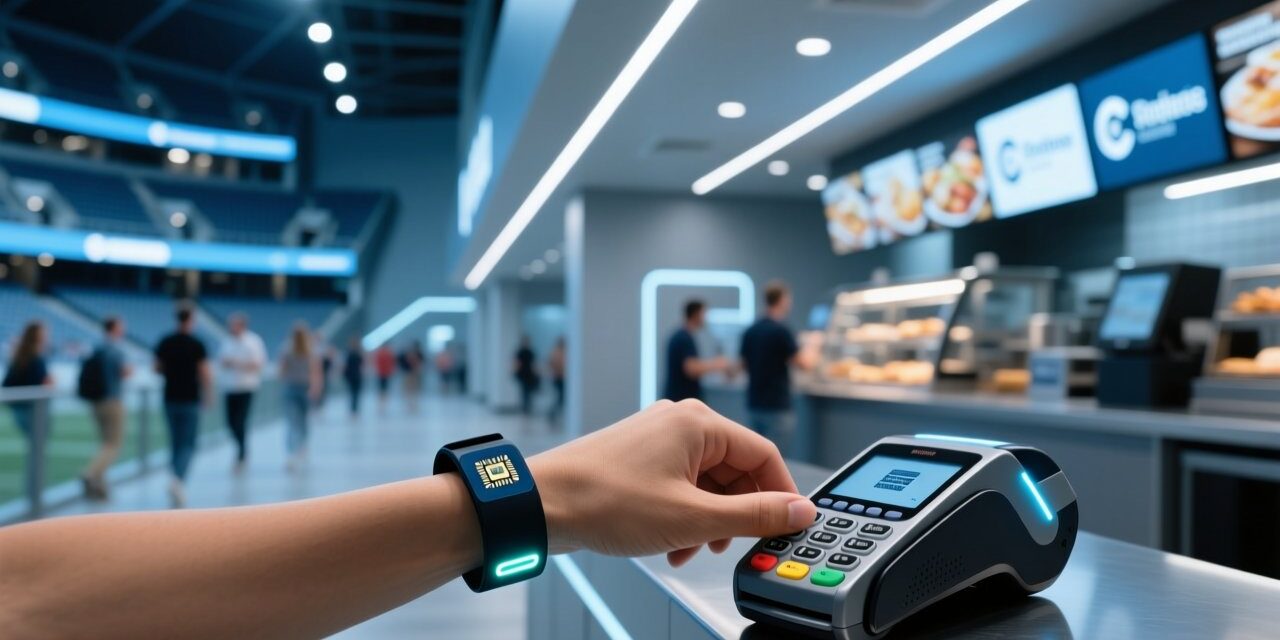
Cashless stadium operations are no longer an experiment; they are a revenue strategy. Stadium finance managers, F&B concession operators, and merchandise directors face the same challenge: long lines, hidden friction, and cash-handling costs that eat into per-fan revenue. A cashless stadium RFID wristband solves this by combining admission, Pagamento, and access control into one wearable credential. Fans tap once; operators get real-time data. The result is a sports venue cashless system that moves faster, sells more, and reconciles cleanly.
This guide is written for revenue owners — not just technology evaluators. It walks through how RFID wristbands work in concessions and merchandise, why they lift per-capita spend, and what finance and operations leaders need to know before rollout.
How a Cashless Stadium RFID Wristband Works
At its core, a cashless stadium RFID wristband is an RFID-enabled credential worn on the wrist. Each wristband contains a chip with a unique ID that can be linked to a prepaid balance, a credit card on file, or a mobile wallet. When a fan taps the wristband on a compatible terminal, the transaction completes in under one second — no PIN, no signature, no phone required. This makes stadium concessions cashless and keeps lines moving even during the busiest halftime or intermission windows.
For fans, the wristband becomes an RFID wristband wallet. For operators, it becomes a closed-loop payment instrument that can also manage gate access, age verification, loyalty rewards, and family spending controls within the same protected environment.
Stadiums can choose the wristband material based on event duration and brand requirements. Durable RFID silicone wristbands suit season-pass holders and VIP tiers, while RFID disposable paper wristbands provide a cost-effective option for single-game admission. For venues that need fast on-site issuance, RFID thermal wristbands can support quick personalization and printing.
Faster Concession Lines: Tap-to-Pay Under 1 Second
Concession line speed is one of the most direct revenue levers in a stadium. Every second saved at the register reduces walk-aways and increases the number of transactions a stand can process. With RFID wristbands, tap-to-pay under 1 second is the design target. Because the transaction does not require a cash drawer, card insertion, or a signed receipt, cashiers can serve more fans per hour.
- No change counting or cash-handling delays
- No EMV chip-card insertion or payment terminal waiting
- No battery or screen wake-up time on the fan side
- Simultaneous access and payment with the same credential
This is the operational core of concession line speed RFID: the credential is always ready, always on the wrist, and readable at short range without line-of-sight alignment. For F&B operators, that translates into higher throughput at existing stands without adding headcount.
Driving Higher Per-Capita Spend with Frictionless Payments
Frictionless payments directly support higher per-capita spending. When payment takes seconds and does not feel like a deliberate cash transaction, fans are more likely to add a second drink, a premium item, or an impulse purchase. A sports venue cashless system reduces the psychological pause that often suppresses add-on sales at register level.
Stadium finance teams can also set spending rules by ticket type: adult accounts, kids’ accounts, VIP accounts, and group accounts can each carry distinct limits or perks. This enables per capita spend stadium strategies that are both fan-friendly and revenue-focused.
Por exemplo, concession operators can offer bundled value — such as a meal deal loaded onto the wristband — that encourages a larger basket at a lower perceived price. Because the wristband is already funded, upsells become easier to complete at the point of sale. The result is not just a faster line, but a larger average transaction.
Merchandise Tap-to-Buy at Team Stores and Kiosks
Stadium merchandise RFID extends cashless payment beyond food and beverage. At team stores, concourse kiosks, and pop-up stands, fans can tap-to-buy jerseys, hats, and collectibles without pulling out a phone or wallet. This uniformity removes a major friction point: if a fan can pay for a hot dog with a wristband but cannot buy a jersey, the experience breaks down — and the sale is lost.
Merchandise directors benefit from the same real-time transaction tracking as F&B operators. Inventory and payment data flow through the same system, making it easier to identify top-selling SKUs by stand, time of day, and event type. A stadium merchandise RFID rollout also opens the door to self-service retail kiosks, where fans can tap, take, and go without a manned register.
Real-Time Vendor Reconciliation and Financial Control
Vendor reconciliation is often a manual, error-prone process in cash-heavy stadium environments. A cashless stadium RFID wristband system changes that by creating a digital record for every transaction. Each tap is timestamped, tied to a station ID, and associated with a unique wristband identifier.
This real-time transaction tracking supports:
- Instant sales summaries by concession stand or retail outlet
- Accurate vendor settlement without end-of-night cash counts
- Audit trails for chargebacks or disputed transactions
- Faster financial close and fewer discrepancies
For finance managers, the sports venue cashless system becomes a control plane, not just a payment rail. The data can be exported to accounting platforms or custom reports, reducing manual reconciliation time and giving vendors confidence in settlement accuracy.
Security, Age Verification, and Parental Controls
Payment security is non-negotiable in a high-volume stadium environment. RFIDHY wristbands can be configured with MIFARE DESFire encryption for secure payments. DESFire offers mutual authentication, encrypted data storage, and resistance to cloning and replay attacks. This protects both fan funds and venue revenue while meeting the security expectations of payment partners.
Beyond payment security, the wristband supports two operational safeguards that matter in stadiums:
Age Verification: Linked ID for Alcohol Sales
Alcohol sales require consistent ID checks, which slow down lines and create compliance risk. With a wristband tied to a verified ID at registration or at a designated verification station, staff can confirm age with a quick scan. The wristband can display a color or marker indicating legal age, allowing servers to pour with confidence. This linked ID for alcohol sales reduces manual ID checks while preserving responsible service standards.
Parental Controls: Spending Limits on Kids’ Wristbands
Family zones and kids’ activations often require a different set of rules. Parental controls on kids’ wristbands allow guardians to set spending limits, restrict certain purchase categories, or require a PIN for higher-value items. This protects families from unauthorized spending while giving children the same tap-to-pay convenience for approved snacks and merchandise.
Unused Balance Refunds and Reload Stations
A common concern for any prepaid payment system is the unused balance refund workflow. Stadiums need a clear process for returning remaining funds after an event. With an RFID wristband system, refunds can be processed online, at reverse kiosks, or through the venue app within a defined window. The wristband ID links to the account balance, so refunds are automated and auditable.
In parallel, reload stations allow fans to add value before, during, or after events. Self-service kiosks and staffed top-up points make it easy for fans to fund their wristband wallet with cash, cartão, or mobile payment. This ensures the cashless experience does not exclude fans who arrive with cash, and it gives operators additional opportunities to capture value at the venue.
Integration with Stadium POS and Mobile Wallet Systems
A cashless stadium RFID wristband does not operate in isolation. Integration with stadium POS and mobile wallet systems is essential for scalability. The wristband should be readable by the venue’s point-of-sale terminals and should sync transaction data to the same back office used for inventory, loyalty, and access control.
Common integration pathways include:
- POS middleware that maps wristband IDs to prepaid or credit accounts
- Mobile wallet linking for remote top-ups and balance checks
- Event-day APIs that share sales data with vendor management platforms
- Access control integration to reuse the same wristband for gates and VIP areas
RFIDHY supports consulting on these integration points, helping stadium finance, F&B, and merchandise teams build a unified cashless venue payment stack.
Five-Step Rollout Plan for Stadium Cashless RFID
For finance and operations leaders planning a move to cashless, a phased rollout reduces risk and builds internal confidence.
- Audit high-volume zones. Identify the concession stands and merchandise locations with the longest queue times and highest cash mix.
- Select the wristband form factor. Match RFID silicone, disposable paper, or thermal wristbands to season-pass, single-game, and VIP use cases.
- Define security and control rules. Set MIFARE DESFire encryption, age verification flags, parental limits, and refund windows.
- Integrate with POS and mobile wallet systems. Work with your POS provider and RFIDHY to map wristband IDs to accounts and transaction data.
- Pilot and measure. Run a controlled pilot at one section of the venue, track line speed and sales lift, then scale to full stadium.
Measuring Success: KPIs for Finance, F&B, and Merchandise
A cashless stadium RFID wristband rollout should be tied to measurable outcomes. While every venue is different, the following KPIs can guide evaluation:
- Average concession transaction time before and after cashless go-live
- Per-capita food and beverage spend by event and ticket tier
- Merchandise conversion rate at team stores and kiosks
- Vendor reconciliation time per event
- Refund completion time for unused balances
By tracking these metrics, finance managers can directly connect RFID wristband technology to revenue impact and operational efficiency.
RFID Wristband Cashless System at a Glance
| Operational Area | Traditional Payment | RFID Wristband Cashless |
|---|---|---|
| Concession speed | Cash counting, card insertion, receipts | Tap-to-pay under 1 second |
| Per-capita spend | Friction slows add-on purchases | Frictionless payments boost basket size |
| Merchandise | Separate payment step at team stores | Tap-to-buy at stores and kiosks |
| Vendor reconciliation | Manual cash counts and spreadsheets | Real-time transaction tracking |
| Security | Cash loss and card fraud risk | MIFARE DESFire encryption and account controls |
| Family controls | No spending limits for minors | Parental controls with limits and category rules |
FAQ
How does a cashless stadium RFID wristband link to a fan’s payment account?
RFID wristbands can be linked to a prepaid balance loaded at purchase, a credit card on file, or a mobile wallet. The wristband ID is matched to the account in the venue’s payment system, so each tap triggers a secure transaction.
Can RFID wristbands really process concession payments in under 1 second?
Sim. Passive RFID wristbands do not require a battery or device wake-up. When a fan taps the wristband on a compatible reader, the transaction can complete in under one second, which is significantly faster than cash or chip-card payments.
How do stadiums handle alcohol sales with RFID wristbands?
RFID wristbands can store a linked ID or verification flag. After an age check at a designated station, the wristband can indicate legal age to staff, allowing faster and compliant alcohol service without repeated ID checks at every stand.
What happens if a fan does not spend the full balance on the wristband?
Venues can offer an unused balance refund workflow through online portals, on-site kiosks, or the stadium app. The wristband ID links to the account, making refunds easy to track and process.
Can RFID wristbands integrate with existing stadium POS systems?
Sim. RFID wristband systems typically integrate with stadium POS and mobile wallet systems through middleware or APIs, allowing transaction data, Inventário, and access control to share a common back office.
Plan Your Cashless Stadium Rollout with RFIDHY
RFIDHY provides RFID silicone wristbands, disposable and thermal wristband options, and integration guidance for cashless stadium operations. Whether you are upgrading a single concession zone or rolling out a full sports venue cashless system, our team can help you match the right wristband to your payment, access, and security requirements.
Contact RFIDHY to discuss your stadium project, request samples, or schedule a consultation with our RFID specialists.