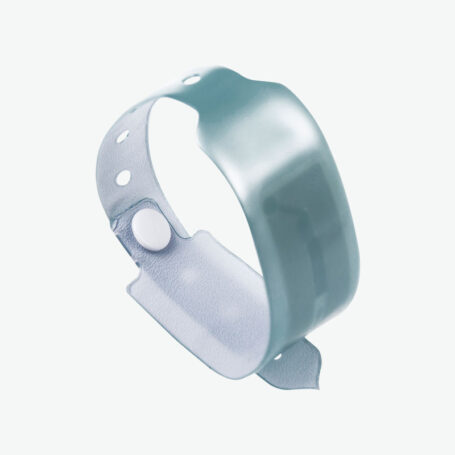

RFID Patient Wristbands for Hospitals and Care Facilities
In one sentence: an RFID patient wristband links a physical person to their digital record at the point of care, so identification stops depending on a nurse reading a barcode in poor light or asking a sedated patient their date of birth.
The choice that matters most is not the chip brand — it is whether you deploy Hf (13.56 MHz) for bedside verification, UHF (860–960 MHz) for ward-level presence tracking, or a dual-frequency band that does both. Everything else (Material, Impressão, encerramento, conformidade) follows from that decision.
What a patient wristband actually has to do
Most hospitals start with barcode wristbands and hit the same four limits:
| Requirement | Barcode band | RFID band |
|---|---|---|
| Read without line of sight | No — must be presented, flat, clean | Yes — read through bedding, Roupa, bandage |
| Read while patient is asleep or uncooperative | Não | Sim |
| Bulk verification at ward round | One at a time | 20–50 tags per pass (Hf) or tens of metres (UHF) |
| Survive disinfectant, banho, MRI proximity | Print degrades | Depends on inlay and encapsulation |
| Write data at point of care | Não (read-only) | Sim (DESFire / NTAG 424 ADN) |
A barcode is not wrong — it is cheap, universal and every printer supports it. The practical answer for most facilities is dual: keep the barcode for legacy systems, add an RFID inlay for the workflows that barcode cannot serve. See barcode vs RFID patient wristbands for the full trade-off table.
Choosing frequency: Hf, UHF, or both
| Hf 13.56 MHz | UHF 860–960 MHz | |
|---|---|---|
| Typical standard | ISO 14443A (MIFARE), ISO 15693 (ICODE) | ISO 18000-6C / EPC Gen2 |
| Intervalo de leitura | 2–10 cm (phone NFC) to ~1 m (portal) | 1–8 m, ajustável |
| Best for | Bedside scan, verificação de medicação, phone-based patient check-in | Ward-level presence, asset+patient association, mass casualty triage |
| Weakness | Short range by design | Read leakage into adjacent beds; needs shielding discipline |
| Typical chip | MIFARE DESFire EV3, NTAG 424 ADN | Monza R6, UCODE 9 |
Decision rule used in practice:
- Only bedside verification and closed-loop medication → HF only, lowest cost, no privacy exposure from stray reads.
- Ward occupancy, elopement detection, or triage at scale → UHF, but plan reader placement carefully; a ceiling reader will read the next bed’s tag too.
- Both workflows in one facility → dual-frequency band, one physical band, two inlays.
Chip-level detail lives in the MIFARE selection guide: MIFARE DESFire vs Clássico vs Ultraleve.
Wristband material and printing for clinical use
Hospitals run two very different supply models, and the material decision follows the model, not the other way round.
Single-use (admission band, discharged with the patient)
| Material | Print method | Typical life | Notes |
|---|---|---|---|
| Direct thermal paper / synthetic | Thermal printer at admission desk | 3–10 days | Cheapest; print fades with alcohol sanitiser — specify a topcoat grade |
| Thermal-transfer synthetic | Ribbon printer | 10–30 days | Survives disinfectant wipes; higher consumable cost |
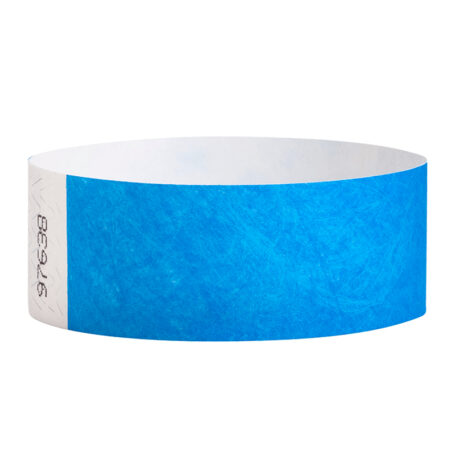
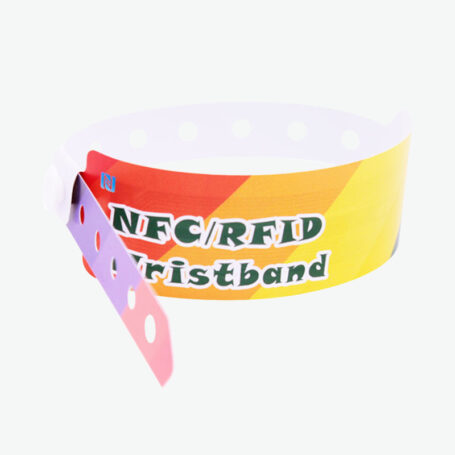
| PVC macio / vinyl with RFID inlay | Pre-printed or laser | 5–14 days | Inlay protected from flexing; common for HF bands |
Reutilizável (estadia longa, care homes, maternity, mental health)
| Material | Cleaning | Typical life | Notes |
|---|---|---|---|
| Silicone with sealed inlay | Wipe-down or washer-disinfector | 2–5 years | Highest upfront cost, lowest per-patient-day cost |
| TPU / elastomer | Wipe-down | 1–3 years | Softer edge, better for dementia patients |
| Stainless or polymer clasp | Autoclavable variants exist | Anos | Needed where bite/pull risk is high |
Closure type is a safety decision, not a cost decision. Adhesive closures cannot be re-tightened without destroying the band (good for tamper evidence, bad for oedema). Clip closures can be re-fitted but are a choking/ligature consideration in mental health and paediatric wards. Specify the closure per ward, not per hospital.
Biocompatibility: for anything in prolonged skin contact, ask the supplier for ISO 10993 skin-sensitisation and cytotoxicity test reports. This is the single most common gap in Chinese-supplier documentation and the most common cause of a failed hospital trial.
The compliance map (this is what procurement actually asks)
| Framework | Applies to | What it constrains in a wristband deployment |
|---|---|---|
| HIPAA (US) | Any PHI stored on or linked to the tag | Do not write patient name/DOB to the tag; store an opaque ID and resolve in the EHR. Log every read. |
| NHS DSPT (UK) | NHS trusts and suppliers | Supplier must complete the DSPT; data processing agreement required |
| ISO 13485 | Supplier QMS if the band is a medical device accessory | Ask for the certificate; check scope covers wristbands, not just “medical devices” |
| ISO 10993 | Skin contact | Biocompatibility test reports (sensitisation, irritation, cytotoxicity) |
| GDPR / UK GDPR | EU/UK deployments | Lawful basis for location data; retention limit; right of access |
| FDA UDI | US, where the band carries a device identifier | UDI carrier rules if the band is part of a regulated device |
The HIPAA point deserves emphasis because it is where most pilots go wrong: the tag should carry an identifier, not a person. Writing SMITH, JOHN 03/14/1958 onto a read/write tag turns a lost wristband into a reportable breach. Write only an internal MRN surrogate, then resolve it server-side. Detalhes: HIPAA compliance for RFID patient wristbands.
Medication safety: where the ROI actually comes from
Closed-loop medication administration works like this:
- Nurse scans their own badge (staff ID).
- Nurse scans the patient’s wristband.
- System checks the order for that patient, that drug, that dose, that route, that time — the “cinco direitos”.
- Administration is charted automatically; a mismatch blocks the screen.
The value is not the scan itself, it is the hard stop. Published hospital case studies report reductions in medication errors of up to 86% after closed-loop verification was introduced — but the figure is highly sensitive to how strictly the hard stop is enforced. A deployment where nurses can override with a single click will not reproduce that number.
Two design details that decide whether this works:
- Inlay placement. Put the inlay on the dorsal side of the wrist, not under the clasp. A tag under the clasp gets compressed and reads unreliably after a few days.
- Read confirm before charting. Never chart on a successful screen tap — require a confirmed read event, otherwise a proximity read in a four-bed bay can chart the wrong patient.
Deeper walkthrough: reducing medication errors with RFID patient wristbands.
Maternity and infant matching
Mother–baby mismatch is a never-event, so the workflow is deliberately redundant:
- Mother and infant wear paired bands carrying a matched pair ID, not just individual IDs.
- Any transition (berçário, theatre, discharge) requires a two-band co-read — the door alarm only clears when both bands are present together.
- Tags must be single-use and tamper-evident; a reusable band on an infant is a ligature and infection-control risk.
UHF is often preferred here because a doorway portal can read both bands without staff intervention. Note that infant skin contact requirements are stricter — specify ISO 10993 reports specifically for the neonatal use case, not just the adult band. See mother–baby matching with RFID wristbands.
Dementia and wander prevention
For care homes and dementia wards the requirement is different again: not identification, Mas boundary awareness.
| Approach | How it works | Trade-off |
|---|---|---|
| Door-mounted HF portal | Short-range read at the doorway | Low stray reads; only works if the resident passes close to the reader |
| Ceiling UHF reader | Zone-level presence | Wider coverage; reads neighbouring rooms without tuning |
| Wearable with button | Resident-initiated call | Depends on the resident remembering to press |
The practical configuration for most facilities is UHF zone readers at exits only, with alerting to staff handsets, and no tracking inside the resident’s own room. That keeps the deployment proportionate under GDPR and avoids creating a surveillance record that has to be justified.
Full care-home model: RFID wristbands for assisted living and elderly care.
Staff access control and attendance
The same band infrastructure usually extends to staff, with a different tag population:
- Zone-based access — pharmacy, controlled-drug store, ICU, theatre.
- Attendance — automatic check-in at ward entry, no separate clock-in.
- Hand hygiene auditing — reader at dispenser plus reader at bed space (only viable with HF, because UHF cannot localise to a single bed).
Staff bands are normally reusable silicone with HF inlay, because staff tolerate a heavier band and the cost model rewards reuse. See hospital staff access control.
Emergency departments and mass casualty triage
The ED is where wristband design gets tested hardest, because throughput and accuracy are in direct conflict.
In a normal ED shift, a band is printed at triage and must survive 4–12 hours of movement, imaging, and body fluids. In a mass casualty event, hundreds of unidentified patients arrive within minutes and the band becomes the only reliable identity anchor until reconciliation.
| Scenario | Band choice | Porque |
|---|---|---|
| Routine ED | Single-use thermal synthetic with HF inlay | Cheap, printable at triage, survives a shift |
| Mass casualty / disaster | Pre-numbered single-use bands, no printing step | Printing is the bottleneck; pre-numbered bands let you start tagging immediately |
| Unidentified patient | Band carries a temporary ID only, never a name | Identity is established later; the band must not assert an identity that is not yet known |
Two rules that come out of real deployments:
- Never make printing a prerequisite for tagging. If the band must be printed before it can be applied, a surge becomes a queue at the printer. Keep a stock of pre-encoded bands for surge use.
- Temporary IDs must be resolvable. A temporary ID that exists only on the band and not in the system is worse than no band at all — it creates a false record. The reconciliation workflow has to be designed with the ED clinical team, not by IT alone.
See mass casualty triage with RFID wristbands e disposable wristbands in US emergency rooms.
Integração: what has to talk to what
| Layer | Typical components | What to specify |
|---|---|---|
| Marcação | HF or UHF inlay in band | Chip model, tamanho da memória, read/write vs read-only |
| Capture | Bedside handheld, fixed portal, ceiling reader | Interface (BLE / Wi-Fi / USB), SDK availability |
| Middleware | Vendor middleware or EHR integration engine | Whether it resolves tag ID → MRN → order |
| EHR / ADT | Epic, Cerner, Oracle Health, local systems | HL7 v2 ADT feed, FHIR Patient resource |
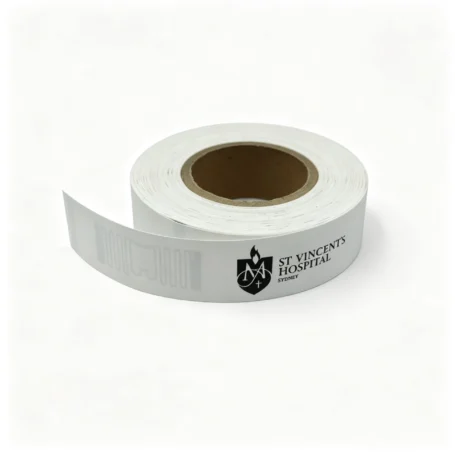
| Impressão | Thermal printer at admission | Whether printer can encode the inlay in the same pass |
The failure mode in most failed pilots is at the intermediário layer: the hardware reads fine, but nobody built the resolution service that maps a tag to a live MRN. Budget for that work explicitly — it usually costs more than the bands.
Perguntas frequentes
Can we keep our existing barcode printers?
Yes if you choose a dual band (printed barcode + Incrustação RFID) and your printer model supports inlay encoding. If it does not, the usual pattern is a separate desktop encoder at admission, which adds a step to the workflow.
Is it HIPAA-compliant to store patient data on the wristband?
Only if the data cannot identify the patient on its own. The safe pattern is an opaque identifier resolved in the EHR. Writing name or DOB to a read/write tag is the most common compliance mistake we see.
HF or UHF for a 600-bed hospital?
HF for bedside and medication workflows; UHF only if you need ward occupancy or elopement detection. Many facilities run HF first and add UHF zone readers at exits later, rather than buying dual-frequency bands for everyone on day one.
What read range should we specify?
Specify the fluxo de trabalho, not the range. “Must read reliably through a blanket at 30 cm” is a testable requirement; “1 metre read range” is not, because it depends entirely on reader and antenna.
How long do bands last?
Single-use thermal bands: 3–10 days depending on topcoat grade. Reusable silicone: 2–5 years, but specify the cleaning method, because washer-disinfector cycles age silicone far faster than wipe-down.
Do you supply the middleware?
No — and be suspicious of anyone who says yes and cannot name the EHR integrations they have shipped. We supply bands, inlays and the encoding specification; integration is normally done by your EHR partner or a specialist integrator.
Next step
Send us your ward profile (bed count, length of stay, current band type, EHR system) and we will return a specification sheet with chip recommendation, Material, closure and a costed single-use vs reusable comparison.
Request a specification and sample pack →