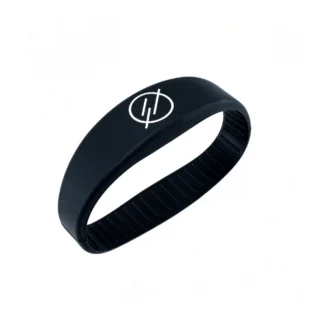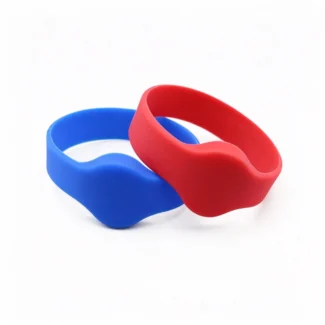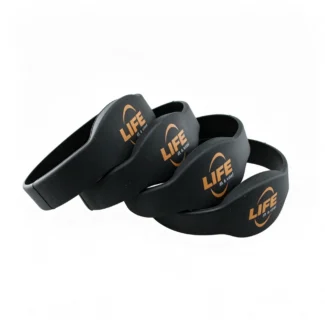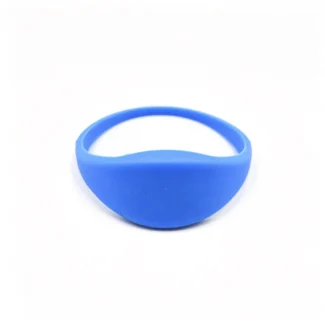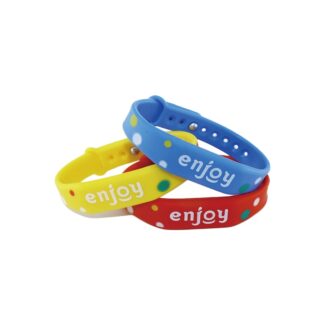


Pulseiras RFID para estádios e instalações esportivas
In one sentence: a venue wristband does three jobs at once — it proves entitlement at the turnstile, it pays at the concession stand, and it records where the holder went; the engineering question is which of those three your frequency choice can actually support.
Most venues get the first two right and underestimate the third, then discover that UHF readers in a concourse create a privacy record nobody agreed to and a data volume nobody budgeted for.
The three jobs, and why they pull in different directions
| Job | Requirement | Frequency that fits |
|---|---|---|
| Entitlement — season ticket, single match, VIP zone | Fast, deterministic read at a fixed point | Hf (13.56 MHz) at a tap point, or UHF at a gate portal |
| Pagamento — concessions, mercadoria, upgrades | Chip with cryptographic authentication, offline tolerance | HF only — MIFARE DESFire EV3 or NTAG 424 ADN |
| Movement data — dwell time, congestion, zoning | Bulk reads over distance | UHF (860–960 MHz) |
The conflict: payment needs HF, congestion analytics needs UHF. You cannot get both from a single passive inlay at a single price point.
Three deployment patterns exist in practice:
- HF only — tap at turnstile, tap at concession. Simplest, cheapest per band, no stray reads, but no congestion analytics and slower throughput at gates.
- UHF only — walk-through gates, bulk reads. Excellent throughput and analytics, but cashless payments need an additional HF element or a closed-loop stored-value system that does not require cryptographic tap.
- Dual-frequency band — HF for payment and entitlement, UHF for movement. Highest band cost, one credential, full capability.
Most stadiums below ~40,000 capacity are better served by HF only plus a stored-value model, because the analytics rarely justify doubling the band cost across a 40,000-person gate.
Gate planning: the arithmetic, not the marketing number
Vendors quote “throughput” figures that are never comparable, because they depend on reader placement, antenna, tag orientation and how the gate is staffed. Do the arithmetic for your own venue instead:
Required gates = peak 30-minute arrivals ÷ (per-gate throughput × 30)
Per-gate throughput = measured in a pilot, not taken from a datasheet
Two practical rules that hold across venues:
- Throughput is set by human behaviour, not by the reader. A tap gate that requires the holder to stop and present the band will run at whatever speed people stop and present. A walk-through UHF portal removes the stop, which is where the throughput gain actually comes from.
- Design for the failure mode, not the average. The gate has to work when a band is bent, worn under a sleeve, or carried in a pocket instead of on the wrist. Specify a fallback path (manual scan, supervisor override) before opening day.
Detailed gate and zone architecture: RFID wristbands for stadiums and sports venues.
Marathon and race timing
Race timing has a different technical profile from stadium access:
| Requirement | Typical choice | Porque |
|---|---|---|
| Passive detection at mats | UHF passive (EPC Gen2) | No battery, 1–8 m read at a mat, thousands of simultaneous reads |
| Split timing | Multiple mats, timestamped reads | Needs clock sync across mats |
| Spectator and family tracking | Not usually RFID | Privacy cost outweighs value; use app-based opt-in |
| Gear check | HF or barcode | Short range, high accuracy, baixo custo |
The critical specification is simultaneous read performance under density — a start corral is the worst-case RF environment on the course. Ask for a measured read rate at your expected density, not a bench figure.
Race-specific workflows: marathon and race RFID wristbands.
Deployment timeline (working backwards from opening day)
| When | What |
|---|---|
| T−90 days | Frequency decision locked; band and inlay specified; gate throughput pilot booked |
| T−60 days | Pilot on one gate and one concession stand; measure real throughput and read failure rate |
| T−45 days | PDV / access-control integration complete; offline tolerance tested by pulling the network |
| T−30 days | Staff training; refund and dead-band procedures documented |
| T−14 days | Full-venue dress rehearsal with 500+ real bands, including deliberate failures |
| T−7 days | Freeze. No configuration changes after this point. |
| T+1 day | Post-event read: failure rate, queue times, refund volume |
The T−14 rehearsal is the step most often skipped and the one that surfaces the integration gaps.
Zoning, accreditation and workforce bands
A stadium runs two credential populations that are frequently conflated in procurement, and conflating them is how you end up with workforce staff holding a band that can also buy beer.
| Population | Band type | Capability | Reuse |
|---|---|---|---|
| Guests | Single-use or event-reusable | Entry, acesso à zona, Pagamento | Low reuse; replaced per event or per season |
| Workforce | Reusable silicone, Hf | Accredited zones, clock-in, no payment | Multi-season, returned at end of shift |
Design rules that avoid the common failures:
- Separate the credential, not just the permission. A guest band that is technically capable of workforce zone access is a security finding waiting to happen. Use different chip configurations, not different software flags.
- Accreditation zones change between events. Football, concert and rugby configurations differ. The band is the constant; the zone rules must be data, not burned into the band.
- Lost workforce bands need a kill switch. A reusable staff band that walks out of the building must be revocable before the next event, which means the access decision has to be server-side.
Integration checklist
Before opening day, each of these interfaces has to be proven with the network deliberately broken:
| Interface | Question to answer | Failure symptom if skipped |
|---|---|---|
| Band → turnstile controller | Which credential format does the controller accept? | Gate reads the band but denies entry |
| Band → POS terminal | Does the terminal authorise offline? | Queues stall when Wi-Fi drops |
| POS → settlement | How and when does money reconcile? | Guests charged twice or not at all |
| Access system → ticketing | Is entitlement checked against the live order? | Resold or cancelled tickets still enter |
| All systems → logging | Is there one place to investigate a disputed entry? | No answer to “why was I denied” |
The single most valuable pre-event test is pulling the network for 15 minutes during a live rehearsal. It is the only way to find out whether your offline tolerance claim is real.
Cost model
Band cost per attendee   = unit cost ÷ reuse cycles (0 for single-use)
Total credential cost    = band cost + encoding cost + replacement rate
Replacement rate matters: venues typically lose 2–8% of reusable bands per event
The line that flips most business cases is replacement rate, and it is almost always omitted from vendor quotes. Ask for the assumed rate in writing.
Perguntas frequentes
Do we need dual-frequency bands?
Only if you need both cryptographic payment (Hf) and congestion analytics (UHF). Below roughly 40,000 capacity, HF-only with a stored-value model is usually the better economic trade.
Can attendees use their phone instead of a band?
Yes for entry, and many venues now default to it. The band earns its place where phones fail: water exposure, no battery, Luvas, children without devices, and guests who do not want to hand over an unlocked phone at a concession stand.
How do we handle a band that will not read?
Design the fallback before opening day: a supervisor terminal that can look up the holder by order number, plus a manual override log. Every venue needs this, and it is always cheaper designed than improvised.
What happens to personal data collected at the gate?
Under GDPR and UK GDPR, movement data is personal data. Minimise it (aggregate rather than per-person where possible), set a retention limit, and document the lawful basis. A wristband that logs every tap for a season is a data asset with an obligation attached.
Will a UHF portal read the wrong person?
Sim, if it is not tuned. UHF reads through clothing, bodies and adjacent lanes. If accuracy matters more than throughput, use HF; if throughput matters more, invest in antenna placement and shielding rather than in a better tag.
Do you supply gates, readers and POS?
Não. We supply bands and inlays to your specified chip, plus the encoding specification. Gate hardware, POS and middleware come from your venue-technology vendors, and the integration is normally led by them.
Next step
Send us your venue profile (capacity, gate count, current credential, POS vendor, event calendar) and we will return a specification with frequency recommendation, chip model, band type and a costed model including replacement rate.
Request a venue specification →