
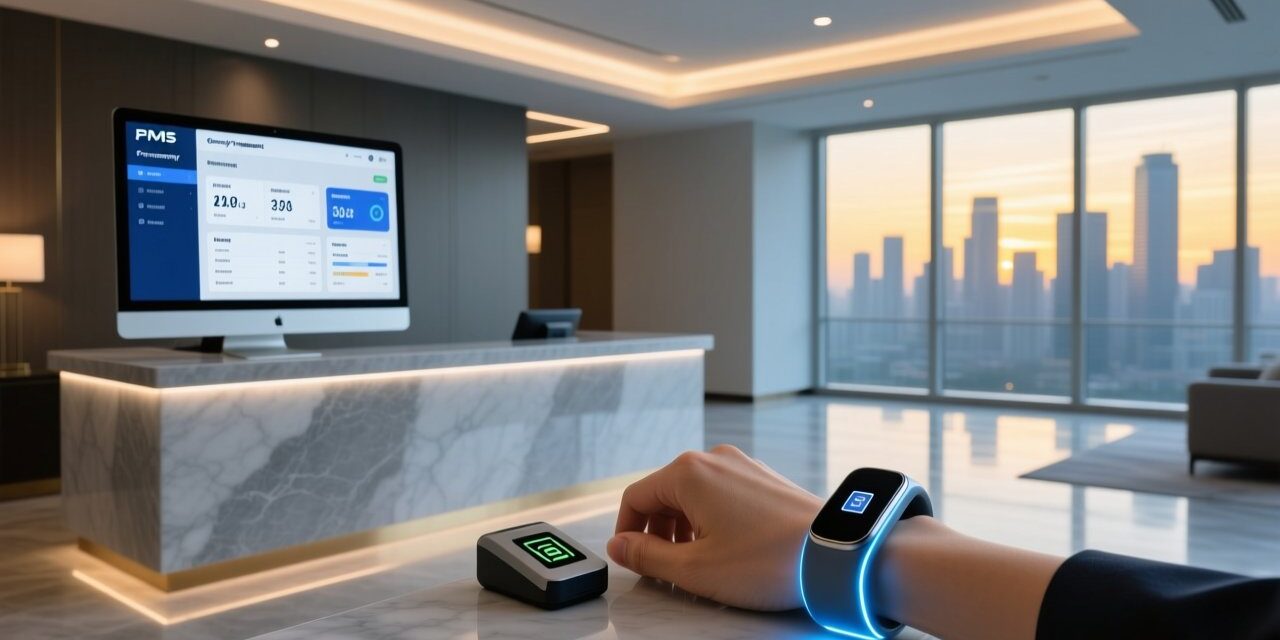
Introduction: The New Standard for Hotel Guest Experience
In today’s competitive hospitality landscape, a frictionless, personalized guest journey is paramount. RFID wristbands have emerged as a key enabler, condensing room access, cashless payments, and identity management into a single wearable token. Sin embargo, the true value emerges only when these wristbands are deeply integrated with the hotel’s property management system (PMS). For IT managers and system integrators, achieving seamless data flow between front‑desk check‑in, door locks, F&B outlets, and energy controls demands a rigorous understanding of the underlying integration architecture, protocol choices, and encoding standards. This guide dissects the technical building blocks, with special focus on Oracle Opera and Oracle Opera Cloud, and equips you with the knowledge to deploy a future‑proof hotel RFID ecosystem.
PMS Integration Architecture: The Core Components
A robust hotel RFID wristband integration architecture typically consists of three layers:
- PMS Layer: The central reservation and guest management system (e.g., Oracle Opera, Opera Cloud, or a hospitality platform). It holds the master guest record, room assignment, billing profiles, and service entitlements.
- Middleware / Integration Server: A broker that translates PMS events into wristband commands and vice versa. This component handles API calls, socket connections, and data transformation. It often hosts the encoding rules, security policies, and audit logs.
- Edge Layer: Physical devices—encoding stations at the front desk, door lock readers, POS terminals, and energy saver switches. These may communicate via Wiegand, OSDP, RS‑485, or IP, depending on the deployment.
The middleware is the heart of the system. It subscribes to PMS events (check‑in, room change, check‑out) and translates them into write commands for MIFARE DESFire chips on the wristband. Simultaneously, it forwards door access logs, payment transactions, and energy usage data back to the PMS for unified reporting.
Oracle Opera / Opera Cloud Compatibility
Oracle Opera remains the most widely deployed PMS in upscale hotels. Integration with RFID wristband systems is typically accomplished through one of three well‑documented interfaces:
- Oracle Hospitality Integration Platform (OHIP): Opera Cloud’s RESTful API framework. It exposes endpoints for guest creation, room assignment, key encoding requests, and folio posting. RFIDHY’s integration server can call these endpoints securely using OAuth 2.0, enabling real‑time data sync.
- FIAS (Fidelio Interface Application Specification): A mature, TCP/IP‑based protocol used by older Opera on‑premise installations. It defines fixed‑length messages for check‑in, check‑out, and key events. While legacy, many lock systems still rely on it, and a bridge between FIAS and modern HTTP APIs is often implemented.
- Oracle Opera Web Services (OWS): A SOAP/XML interface that predates OHIP but is still supported. It offers granular control over guest profiles and room moves, and can be leveraged for complex multi‑property deployments.
When evaluating a wristband integration partner, ensure they have proven connectors for your specific Opera version. RFIDHY’s middleware includes pre‑built adapters for both Opera on‑premise and Opera Cloud, significantly reducing deployment time.
MIFARE DESFire Multi‑Application File System for Hotels
RFID wristbands used in hotels are predominantly based on MIFARE DESFire EV2/EV3 chips. The chip’s native multi‑application file system is ideal for segregating different hotel services securely:
| Application | File ID | Data Stored | Access Key |
|---|---|---|---|
| Access Control | 0x01 | Room number, access schedule, lock ID | Hotel Master Key |
| Cashless Payment | 0x02 | Guest ID, wallet balance, expiry | F&B Key (diversified) |
| Guest Profile | 0x03 | Loyalty tier, language preference, special requests | PMS Shared Key |
| Energy Saver | 0x04 | Energy flag, room occupancy status | Building Management Key |
Each application is cryptographically isolated, preventing cross‑service data leakage. The PMS integration server writes the relevant files at check‑in using a secure NFC encoder, a process that can be triggered automatically from the Opera interface. The 2‑KB to 32‑KB storage of DESFire provides ample room for additional future applications, such as spa bookings or partner loyalty cards.
Wiegand vs OSDP: Choosing the Right Lock Interface Protocol
The link between the door lock reader and the room’s electronic lock is a critical link. Two protocols dominate:
- Wiegand: A de facto legacy standard that transmits a 26‑bit (or custom‑length) binary string over two data lines. It is extremely simple and widely supported by hotel lock brands, but it transmits data in plain text and is susceptible to sniffing and replay attacks. Wiegand also limits the amount of data transferred, typically just a facility code and ID.
- OSDP (Open Supervised Device Protocol): An RS‑485‑based, encrypted, bidirectional protocol approved by SIA. OSDP supports advanced features: mutual authentication using AES‑128, secure key updates, reader tamper detection, and the ability to send multi‑application data (e.g., payment token alongside access credential) in a single transaction. For hotels using DESFire wristbands, OSDP unlocks the full potential of the multi‑file system because the reader can petition the wristband for a specific application without exposing the credential to the Wiegand controller.
While Wiegand remains prevalent in retrofits, new‑build and large‑scale renovations should adopt OSDP‑capable readers and locks. RFIDHY’s integration platform supports both protocols, with a clear migration path from Wiegand to OSDP using a universal controller that translates between the two.
Standalone Reader vs. Cloud‑Based Reader Architecture
The architecture of the lock reader itself has implications for integration complexity and guest experience:
Standalone (Offline) Readers
- How it works: The wristband is encoded with the room access data at the front desk. The lock reader has a local real‑time clock and an authorization list (often pre‑loaded via a handheld updater or during maintenance). The reader makes an autonomous access decision offline.
- Pros: No dependency on network connectivity; low latency; robust in locations with poor Wi‑Fi.
- Cons: Delayed revocation (a lost wristband cannot be instantly deactivated at all locks); limited ability to support dynamic entitlements; manual audit trail collection via a portable programmer.
Cloud‑Based (Online) Readers
- How it works: The lock reader communicates over Wi‑Fi or Ethernet with the middleware server in real time. The wristband stores only a unique identifier; the access decision and any supplementary data are fetched from the central database.
- Pros: Instant blacklist updates; ability to change room access remotely (e.g., upgrade guest to a suite); real‑time audit logs; simpler wristband encoding (just a UID).
- Cons: Requires reliable network infrastructure; slightly higher latency (mitigated by edge caching); higher lock electronics cost.
Most large resorts now deploy a hybrid approach: cloud‑based for guest room corridors and common areas, with standalone as a fallback if connectivity is lost. RFIDHY’s gateway devices support both modes and can buffer transactions locally during network outages.
Real‑Time Guest Check‑In to Wristband Encoding
The moment a guest arrives at the front desk, the PMS must trigger a seamless wristband encoding process. Here is a typical workflow using Oracle Opera Cloud and RFIDHY’s integration:
- The receptionist completes check‑in in Opera Cloud via the web interface.
- Opera Cloud sends a webhook to RFIDHY’s middleware containing the guest ID, room number, arrival/departure dates, and any linked service packages.
- The middleware looks up the associated RFID access credentials and constructs the command set: for access control (write room access data to file 0x01), for payment (initialize wallet balance to pre‑authorized amount, file 0x02), and for energy saver (activate occupancy flag, file 0x04).
- The command is sent to the NFC encoder at the front desk station. The attendant merely holds the blank wristband to the encoder; within milliseconds, all data is written and verified.
- A confirmation is returned to Opera Cloud, and the guest profile status is updated to “wristband active.”
This entire cycle takes less than three seconds, keeping the check‑in experience quick and impressive. For groups, RFIDHY supports batch encoding through a multi‑slot desktop programmer that encodes up to eight wristbands simultaneously.
Hotel Room Lock Brands: Ensuring Interoperability
RFID wristbands must interoperate with the electronic locks already installed in the hotel. Leading lock manufacturers—ASSA ABLOY Global Solutions (VingCard, Elsafe), dormakaba (Saflok, Ilco), Onity, MIWA, and SALTO Systems—all now offer models that read MIFARE DESFire and NFC‑compliant wristbands. Key compatibility considerations:
- Card Technology Support: The lock reader must be explicitly configured to read DESFire EV1/EV2/EV3 and to decode the custom access application (e.g., file 0x01). Most modern locks support this via a simple firmware update; older magstripe‑only locks require a replacement reader module.
- Authentication Key Delivery: For OSDP‑based locks, the PMS integration can push diversified keys to each lock, ensuring that wristband‑to‑lock authentication is secure and unique. For Wiegand locks, the facility code and key are programmed into the lock’s controller upfront.
- Mobile Access Overlay: Many of these locks also support BLE/NFC guest‑side credentials, allowing the same wristband to be used for primary access while the guest’s smartphone serves as a backup. The PMS middleware ensures both tokens share the same access profile.
Before deployment, RFIDHY’s engineering team performs interoperability testing with the hotel’s specific lock model to guarantee 100% read reliability at all door terminals.
F&B POS Integration for Cashless Payments
Transforming the wristband into a payment token requires integration between the PMS, a cashless payment module, and the F&B point‑of‑sale system. The architecture typically flows as follows:
- Wallet Provisioning: At check‑in, the guest’s credit card is pre‑authorized, and a corresponding wallet amount is written to the payment file on the wristband (or stored on the central server if using cloud‑based readers).
- Transaction at POS: A pool‑side bar or restaurant server taps the wristband on an Lector RFID connected to the POS. The POS system reads the guest ID (and optionally the wallet balance), deducts the charge, and prints a receipt. For offline readers, the wristband’s local purse is decremented; for online readers, the charge is immediately posted to the central folio.
- Folio Synchronization: All charges must be posted back to the PMS guest folio for final settlement. The cashless server batches transactions and pushes them to Opera Cloud via the OHIP API or direct SQL‑based integration. At check‑out, any remaining wallet balance is refunded to the credit card on file.
For security, all payment‑related data on DESFire is protected by diversified keys derived from the guest’s unique ID, meeting PCI DSS guidelines for contactless payments.
Energy Saver Switch Integration
Hotel energy saver switches are a low‑tech but highly effective way to cut electricity costs. When integrated with wristbands, they become smarter:
- Occupancy Detection: The switch requires a valid wristband tag to enable power in the room. When the guest taps the wristband on the reader near the door, the energy saver circuit closes, activating lights, HVAC, and outlets.
- PMS Communication: Through the building management system (BMS) interface, the middleware can report occupancy status to the PMS. This allows housekeeping to know when the room is empty, and can automatically switch the thermostat to an eco‑mode when the wristband is removed for an extended period.
- Multi‑Application Advantage: The DESFire wristband carries a file (0x04) with the room occupancy flag. The energy saver reader reads this file and, if the occupancy bit is set, authorizes power. No central server is required; the lock operates autonomously. This is particularly useful in standalone lock architectures.
Check‑Out: Automatic Wristband Deactivation and Data Sync
A smooth departure process is as critical as check‑in. The PMS triggers the deactivation workflow:
- When the receptionist processes check‑out in Opera, the PMS sends a deactivation event to RFIDHY’s middleware.
- The middleware instantly blacklists the wristband’s UID in the central database. For online locks, this takes effect immediately, blocking all room access.
- For offline locks, a “kill” command can be written to the wristband’s access file if the guest returns the wristband physically. If not, the blacklist is propagated through the next lock update cycle (or by walking a handheld programmer to the corridors).
- The payment file is marked as expired, and any residual balance is refunded. The wristband itself can be left with the guest as a souvenir (with all sensitive data erased) or collected for sanitization and reuse.
- All transaction logs are pushed to Opera, and the guest’s folio is finalized.
With RFIDHY’s solution, a typical check‑out takes under 10 segundos, and the wristband becomes inactive the moment the guest leaves the front desk.
Conclusión: Building a Seamless, Future‑Proof Hotel Ecosystem
Integrating RFID wristbands with Oracle Opera and other hospitality platforms is a multi‑layered engineering challenge that, when done right, delivers exceptional guest satisfaction and operational efficiency. By focusing on a robust middleware, adopting MIFARE DESFire’s multi‑application capabilities, selecting the appropriate lock interface protocol (preferably OSDP), and designing for both online and offline resilience, hotels can create a unified access and payment ecosystem. RFIDHY’s technical consultants are ready to design a custom integration architecture that matches your property’s exact PMS, lock, and operational requirements.
FAQ
Does RFID wristband integration work with Oracle Opera Cloud only, or also on‑premise Opera?
Both. RFIDHY provides pre‑built adapters for Opera Cloud via OHIP REST APIs and for on‑premise Opera through FIAS or Oracle Web Services (OWS). The same middleware can bridge the two, making it suitable for properties migrating from on‑premise to cloud.
Can the wristband work with multiple lock brands within the same resort?
Sí. MIFARE DESFire is a global standard supported by all major lock manufacturers. RFIDHY’s integration profiles allow you to define different lock configurations for different zones (e.g., dormakaba for guest rooms, SALTO for spa access). The wristband carries the appropriate credentials for each zone.
What network infrastructure is required for cloud‑based readers?
Each online lock reader requires either a Wi‑Fi connection (2.4 GHz with WPA2‑Enterprise security) or a wired Ethernet drop. RFIDHY recommends a dedicated VLAN for access control traffic to ensure low latency and security. For outdoor kiosks, LoRa or proprietary 900 MHz bridges can be used as alternatives.
How does the wristband handle multiple guests in the same room?
Each guest receives a wristband with a unique UID but the same room access data (file 0x01). The PMS creates distinct folios for billing. For energy saving, the room is considered occupied as long as at least one valid wristband remains within the energy saver’s range.
Is the payment data on the wristband PCI compliant?
When only a token (guest ID) is stored on the wristband and the actual wallet balance is held on a secure server, the wristband does not store sensitive cardholder data, simplifying PCI scope. If local purse is used on the chip, it is isolated in a dedicated DESFire application encrypted with diversified keys, and the stored value mirrors a pre‑authorization amount, not direct card details.
Let’s Design Your Hotel’s Integrated RFID Ecosystem
RFIDHY specializes in end‑to‑end hotel wristband integration, from Oracle Opera connectivity to multi‑vendor lock interoperability. Our engineers work with your IT team to blueprint the middleware, select the optimal reader architecture, and ensure a zero‑friction guest experience. We offer a free proof‑of‑concept demonstration and detailed technical documentation.
Contact our hospitality solutions team today to schedule a consultation.