
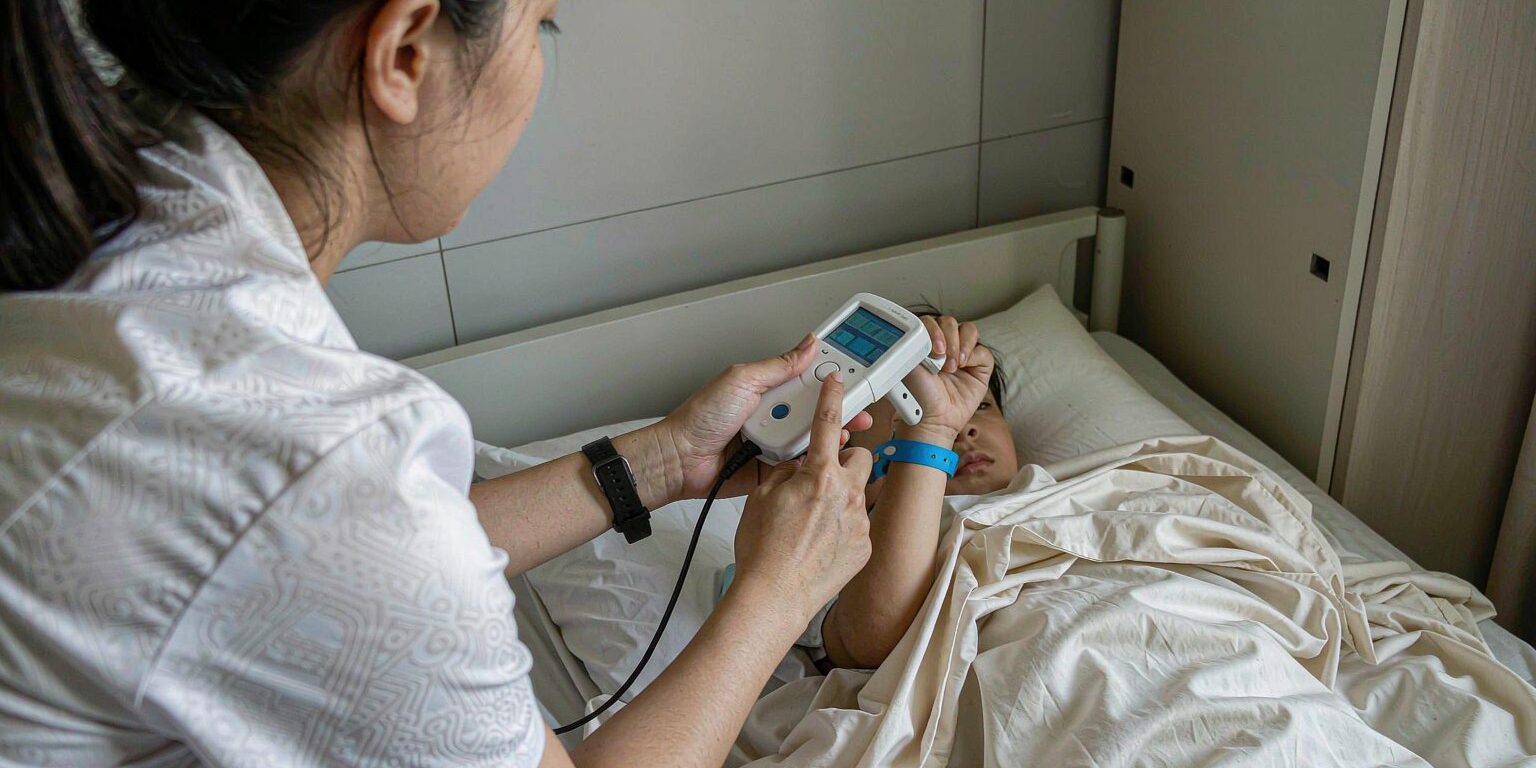
The Patient Identification Challenge in US Hospitals
Medication errors remain one of the most preventable safety risks in hospital care. The Joint Commission’s National Patient Safety Goal NPSG.01.01.01 requires clinicians to use at least two patient identifiers before administering medications, collecting specimens, or performing procedures. In practice, manual wristband checks, verbal confirmation, and barcode scanning still leave gaps: worn or illegible wristbands, look-alike names, language barriers, and high-acuity workflows can all contribute to misidentification.
An RFID patient wristband adds a layer of automated, hands-free identification at the bedside. It carries a unique patient identifier in a small chip that can be read electronically and matched against the electronic health record before medication administration. For hospital administrators and procurement teams, this technology is not only a patient safety tool but also a workflow improvement investment that can reduce downstream costs associated with adverse drug events and manual rework.
How RFID Patient Wristbands Support Safer Medication Administration
A patient wristband equipped with RFID stores a unique identifier that links to the patient’s record in the admission-discharge-transfer and pharmacy systems. When a nurse scans the band at the bedside, the system verifies patient identity against the medication order, allergy profile, and administration schedule. This creates a hard stop before the wrong medication can reach the wrong patient.
The Five Rights of Medication Administration
RFID-enabled patient identification reinforces the core safety checklist that hospital staff already follow:
- Right patient: confirmed electronically by scanning the wristband and matching the unique record
- Right drug: validated against the active medication order
- Right dose: checked against the pharmacy-verified order
- Right route: confirmed with the administration record
- Right time: documented automatically at the point of care
This reduces reliance on manual visual checks and gives nurses an immediate alert if any element is out of range.
Barcode vs RFID: A Practical Comparison
Many US hospitals already use barcode medication administration. RFID is not intended to replace barcode in every workflow, but it can address common barcode limitations. The table below summarizes practical differences for hospital patient identification.
| Factor | Barcode Wristband | Pulseira RFID |
|---|---|---|
| Line of sight | Required | Not required |
| Read range | Very close contact | Near-field or short distance |
| Wristband durability | Print can fade or smear | Chip remains readable if band stays intact |
| Read speed | One at a time | Fast individual read |
| Data on chip | Usually limited to printed ID | Unique ID plus optional encrypted data |
| Wet or soiled conditions | May fail | Often more tolerant |
For medication administration, the key advantage is that RFID scanning can occur without direct line of sight, which is helpful when patients are sleeping, wearing multiple layers, or when wristbands are positioned under medical tubing.
Why HF NFC Wristbands Fit Hospital Workflows
An HF NFC wristband operates at 13.56 MHz and is widely used in healthcare because it offers a short, controlled read range and strong data security. Near-field communication also allows hospital staff to read the band with NFC-enabled mobile devices, which can simplify bedside verification and reduce the need for dedicated handheld scanners in some workflows.
Hospitals can also use supplementary NFC tags on medication bins, patient charts, or high-risk medication storage areas to build a closed-loop identification system. This approach supports positive patient identification without introducing long-range UHF reads that may be less desirable in dense clinical environments.
FDA and Joint Commission Compliance Considerations
The Joint Commission does not mandate the use of RFID specifically, but it does require a reliable process for patient identification. RFID patient wristbands can serve as one of the two approved identifiers when the system is designed to display or confirm the same identifiers used by clinicians. Hospitals should document how RFID-based identification integrates with existing policies and retains the required two-identifier check.
From an FDA perspective, RFID patient identification systems are generally considered part of hospital information technology infrastructure rather than a medical device, but hospitals should work with vendors to ensure that any software used for medication administration supports applicable barcode medication administration requirements and maintains accurate electronic records. Procurement teams should request documentation that confirms the system can integrate with existing pharmacy and ADT platforms and does not alter the medication order verification workflow.
Key Implementation Requirements for Hospital Procurement Teams
Before rolling out RFID patient identification, hospitals should evaluate several operational factors:
- Selecting the right RFID inlays for patient wristbands, considering chip type, memory, and read performance
- Deploying RFID reader modules at medication carts, bedside workstations, and pharmacy verification points
- Designing fallback procedures for lost, damaged, or unreadable bands
- Training nursing and pharmacy staff on new scanning workflows and override policies
- Aligning with infection control requirements for wristband materials and cleaning
Integrating RFID Data into ADT and BCMA Systems
The wristband itself only carries an identifier. The clinical value comes from integrating that identifier with the hospital’s admission-discharge-transfer system, electronic medication administration record, and pharmacy verification software. Middleware can map the unique RFID ID to the correct patient record and present medication orders to the nurse at the point of care. Clear data mapping and HL7 or FHIR interfaces should be part of the procurement specification to avoid manual workarounds.
Security and Patient Privacy
Patient wristbands should store only a unique identifier or encrypted reference, not protected health information. Hospitals should confirm that the RFID system uses appropriate encryption, access controls, and audit logging. Since HF NFC wristbands operate at a short range, they reduce the risk of unintended reads compared with long-range UHF systems. These design choices help hospitals maintain HIPAA compliance while improving medication administration safety.
Procurement and ROI Considerations
From a procurement perspective, the total cost of ownership includes wristband unit cost, reader hardware, middleware licensing, integration services, and ongoing staff training. The potential return comes from fewer medication errors, reduced repeat laboratory draws due to misidentification, lower administrative time spent correcting patient records, and stronger compliance with accreditation requirements. Hospitals should ask vendors for workflow demonstrations, referenceable implementations, and clear documentation on read performance, chip durability, and integration capabilities.
Conclusão
US hospitals are under continued pressure to reduce medication errors and improve patient safety. RFID patient wristbands support positive patient identification at the point of care, reinforce the five rights of medication administration, and complement existing barcode systems. For hospital administrators and procurement teams, the key is to evaluate the full workflow, choose HF NFC wristband technology where security and near-field reading are priorities, and ensure strong integration with existing hospital information systems.
For related guidance, see our article on HF-NFC vs UHF RFID Wristbands and our Silicone vs PVC RFID Wristbands B2B Buyer’s Guide.
Frequently Asked Questions
How do patient identification wristbands help reduce medication errors?
Patient identification wristbands equipped with RFID allow clinicians to electronically verify patient identity before administering medication. The unique identifier on the band is matched against the medication order and allergy profile in the hospital information system, creating a safety checkpoint at the point of care.
Are RFID patient identification systems compliant with Joint Commission requirements?
The Joint Commission requires at least two patient identifiers. RFID systems can support this requirement when the band displays or confirms the same two identifiers used by staff and when the verification process is integrated into the hospital’s patient safety policies. Hospitals should document how the system fits their two-identifier workflow.
Does the FDA require RFID wristbands for medication administration?
Não, the FDA does not mandate RFID wristbands for medication administration. Hospitals should ensure that any associated medication administration software meets applicable barcode medication administration requirements and maintains accurate electronic records. Vendor documentation should confirm integration with existing pharmacy and ADT systems.
What information is stored on a hospital patient ID wristband?
In most hospital deployments, the wristband stores only a unique identifier or encrypted reference number. Protected health information is not stored directly on the band. The identifier links to the patient record in secure hospital systems, which helps maintain privacy and HIPAA compliance.
Can hospital staff scan patient ID wristbands with a smartphone?
Sim, near-field communication-enabled patient identification bands can be read with NFC-capable mobile devices if the hospital’s security policies allow it. This can support bedside verification without requiring a dedicated handheld scanner, though many hospitals still use integrated reader modules at medication carts and workstations.
Talk to Our Healthcare RFID Team
RFIDHY supplies hospital-grade RFID wristbands and supports B2B procurement teams in evaluating patient identification solutions. Contact us to discuss your hospital workflow, request product samples, or schedule a consultation with our healthcare RFID specialists.