
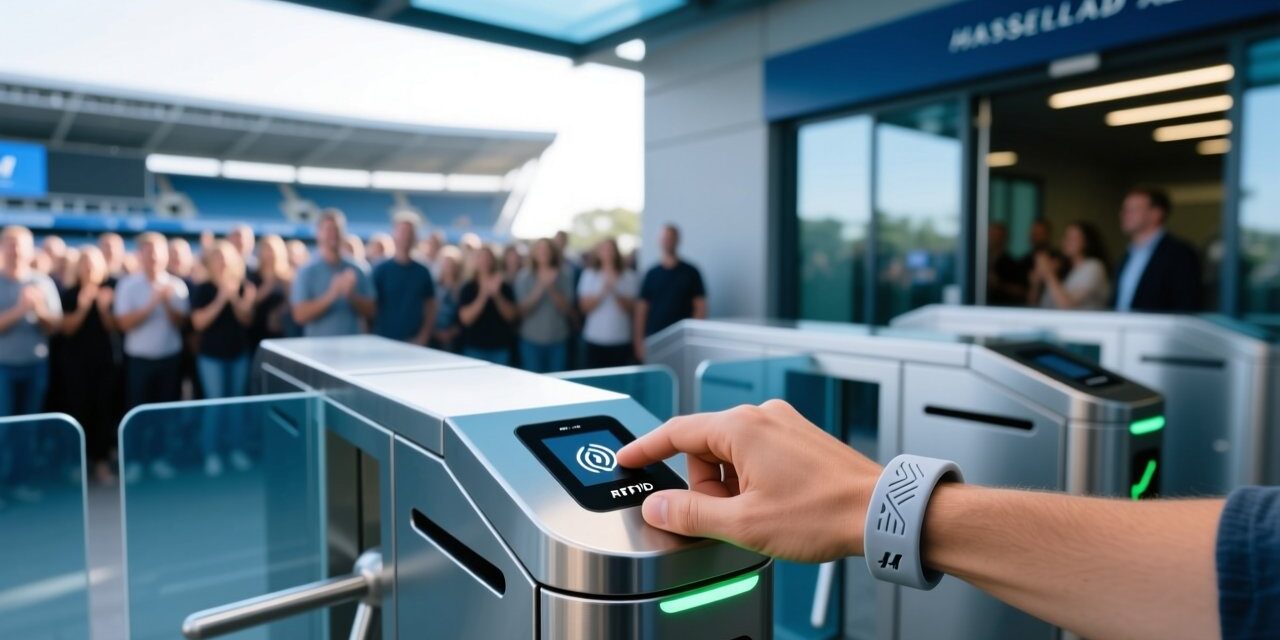
The Access Control Challenge at Stadiums and Sports Venues
Stadium gates are the single highest-friction point in the fan journey. On event day, thousands of ticket holders converge on a limited number of entry lanes. Every second of delay multiplies into long queues, frustrated fans, and increased security risk. Traditional barcode and QR code scanning, while common, introduces bottlenecks: each ticket must be presented on paper or a smartphone screen, aligned precisely with a scanner, and read one at a time. This line-of-sight requirement is slow, error-prone, and easily disrupted by glare, cracked screens, or low battery.
For stadium operations directors, sports venue managers, and event security leads, the goal is clear: increase gate throughput without compromising security. RFID wristbands address this challenge by enabling contactless, tap-and-go entry that works even when the wristband is partially obscured or worn on the wrist. Instead of requiring a visual scan, the wristband communicates with a reader via radio frequency, allowing fans to pass through turnstiles in a fraction of the time.
High-Throughput Gate Access: Batch Reading vs Single Barcode Scanning
One of the primary advantages of RFID in sports venue access control is the ability to read multiple wristbands simultaneously. While a traditional barcode scanner processes one ticket at a time, an RFID reader can energize and identify multiple tags within its read zone. This batch reading capability is especially valuable at checkpoint areas where staff may need to validate groups quickly, such as VIP entrances, hospitality suites, or media gates.
Even at individual turnstiles, the speed difference is dramatic. A barcode scan typically requires the fan to stop, retrieve the ticket, orient it correctly, and wait for a successful beep. With an RFID wristband, the fan simply taps or brings the wrist within a few centimeters of the reader antenna. The transaction completes in milliseconds, and the turnstile releases. No line-of-sight, no screen brightness issues, no manual alignment. This frictionless movement is the foundation of high-throughput stadium entry.
For stadiums transitioning from paper or mobile tickets, the operational shift is straightforward: replace barcode scanners at gates with fixed RFID readers integrated into the existing turnstile housing. The wristbands themselves are encoded with the same ticket information, and the backend system validates each read against the ticketing database in real time.
Turnstile Integration: RFID Reader + Flap Gate Automatic Entry
Modern stadium turnstiles—whether tripod, flap gate, or speed gate—can be equipped with embedded RFID antennas and controllers. The typical configuration places the antenna on the top or side panel of the gate, clearly marked with a tap zone. When a fan presents an RFID wristband, the reader captures the unique identifier, sends it to the access control server, and triggers the gate to open if the credential is valid.
Flap gate systems are particularly well suited for RFID because they offer a wide, barrier-free passage that can be closed instantly if a credential is invalid. This provides both high throughput and a physical deterrent against tailgating. Integration often involves a simple relay or digital I/O connection between the RFID reader and the turnstile controller, with the access logic handled by middleware or directly by the ticketing platform.
The read range of the wristband is a critical design parameter. For stadium wristbands, two ISO standards are commonly used:
- ISO14443A (e.g., MIFARE, NTAG): tap range of 2–5 cm. Ideal for deliberate, close-contact taps at turnstiles. The short range reduces accidental reads from adjacent lanes and improves security.
- ISO15693: read range up to 8 cm. Allows a slightly more forgiving tap, which can speed up entry while still preventing cross-lane interference when gates are properly spaced.
Selecting the appropriate standard depends on the physical layout of the gates, expected fan behavior, and the desired balance between speed and read isolation.
Anti-Fraud and Security: Encrypted UID and Cloned Wristband Detection
Ticket fraud is a constant concern for stadium operators. Counterfeit paper tickets and duplicated barcodes can be produced with relative ease. RFID wristbands provide multiple layers of protection that make cloning and forgery significantly harder.
Every RFID chip has a factory-programmed unique identifier (UID) that cannot be changed. This UID is typically encrypted or paired with additional cryptographic keys stored in the chip’s secure memory. When a fan taps at the gate, the reader performs a mutual authentication challenge with the chip to verify that it is genuine. A cloned wristband copied from a legitimate chip will fail this cryptographic check because it cannot produce the correct response without the secret key.
Beyond chip-level security, the access control system itself can maintain a real-time database of every wristband issued. As each tap is processed, the system checks not only the credential validity but also whether the same UID has already been used to enter the venue. If a duplicate tap is detected at a different gate within a short time window, the system can flag it as a potential cloned wristband and alert security staff. This real-time validation closes the gap that allows copied barcodes to slip through.
Season vs Single-Event Wristbands: Reusable Silicone vs Disposable Tyvek
Stadiums host both season-long sports leagues and one-off events like concerts or special matches. The choice of wristband material and form factor should align with the duration and frequency of use.
For season ticket holders, VIP members, or staff, a durable, reusable wristband is the best option. RFIDHY offers silicone wristband models HYWGJ01 e HYWGJ02, designed for season-long durability. These RFID silicone wristbands are waterproof, resistant to sweat and sunscreen, and comfortable for all-day wear. They can be reused across multiple games, reducing per-event cost and waste. The silicone material also withstands the physical demands of active fans and can be fitted with a tamper-evident closure to prevent transfer between individuals.
For single-event use, disposable RFID Tyvek wristbands are lightweight, cost-effective, and tamper-evident. Tyvek is a tear-resistant synthetic paper that cannot be removed without visible damage, making it ideal for one-day events. These wristbands can be printed with barcodes, seat numbers, and branding while still carrying an RFID chip for entry and cashless payments.
The table below summarizes the key differences:
| Feature | Reusable Silicone (HYWGJ01/02) | Disposable Tyvek |
|---|---|---|
| Durabilidade | High, season-long | Single-event |
| Water resistance | Excellent | Good, but not for prolonged water immersion |
| Comfort | Suave, flexible | Lightweight, paper-like |
| Anti-tamper | Locking clasp or adhesive | Adhesive, tears if removed |
| Best use case | Season passes, VIP, staff | Single matches, concertos, one-day events |
Multi-Gate Synchronization and Real-Time Occupancy Counting
RFID access control is not just about opening gates; it produces a continuous stream of entry data that can be used for crowd management. When all gates are connected to a central server, each tap is timestamped and associated with a specific gate and credential. This allows the venue to monitor in real time how many fans have entered through each gate, how many are still outside, and the current occupancy of different zones.
Multi-gate synchronization ensures that all readers operate on the same clock and database. If a fan earns entry at Gate A, the system immediately updates the central record so that a duplicate tap at Gate B is rejected. This prevents the same wristband from being used to admit multiple people simultaneously.
Real-time occupancy counting also supports safety and operational decisions. If a particular section is nearing capacity, staff can redirect incoming fans to less crowded gates or areas. After the event, the entry data provides analytics on peak arrival times, gate utilization, and flow rates—information that can be used to optimize staffing and gate layouts for future events.
Integration with Access Control and Ticketing Platforms
For RFID wristbands to work seamlessly within a stadium environment, they must integrate with the existing ticketing and access control infrastructure. Most modern ticketing platforms provide APIs that allow RFID readers to query and update ticket status in real time. When a fan taps, the reader sends the wristband UID to the ticketing server, which verifies that the ticket is valid, not already used, and matches the seat or zone. The server then returns an approval command to the turnstile.
Integration can be achieved through middleware that translates between the RFID reader protocol and the ticketing system’s API. This middleware also handles offline scenarios: if the network goes down, the reader can store tap events locally and synchronize once connectivity is restored. No entanto, for real-time anti-fraud and occupancy counting, a stable network connection is recommended.
Many stadium deployments also link RFID wristbands to cashless payment systems, allowing fans to purchase food, merchandise, and upgrades by tapping the same wristband. This unified credential approach enhances the fan experience and provides additional revenue data.
Emergency Evacuation: Staff Override and Instant Gate Release
Safety is the top priority in any stadium. During an emergency evacuation, gates must be able to open immediately and remain open to allow rapid egress. RFID access control systems can be configured with multiple override mechanisms:
- Central command override: From the security control room, an operator can send a global command to all turnstiles to release their locks and enter free-flow mode.
- Staff handheld override: Trained staff can use a handheld RFID scanner or a physical key to override individual gates if the central system is unavailable.
- Fail-safe mechanical release: In compliance with local safety codes, turnstiles can be equipped with a mechanical bar or lever that physically disengages the lock, allowing the gate to swing freely.
These measures ensure that even if the RFID system loses power or network connectivity, evacuation routes remain unobstructed. Regular drills and testing of these override functions are essential.
Operational Best Practices for Stadium RFID Deployments
Implementing RFID wristbands at scale requires careful planning. The following best practices help ensure a smooth rollout:
- Test read performance at every gate: Verify that the read range is consistent across all turnstiles and that adjacent lanes do not cause cross-reads.
- Train staff thoroughly: Gate attendants should know how to troubleshoot common issues, such as a fan presenting the wristband incorrectly or a reader that is out of alignment.
- Provide clear signage: Mark the tap zone on each turnstile and use visual cues to guide fans.
- Plan for network redundancy: Use local caching on readers to handle brief network outages without stopping entry.
- Monitor in real time: Use dashboards to track gate throughput, queue lengths, and occupancy during the event.
By following these guidelines, stadium operations teams can maximize the benefits of RFID wristbands while minimizing disruptions.
FAQ
What is the typical read range of an RFID stadium wristband?
Most stadium wristbands use either ISO14443A chips with a 2–5 cm tap range or ISO15693 chips with up to 8 cm. The shorter range is preferred for turnstile taps to avoid accidental reads from neighboring lanes.
Can RFID wristbands be reused for an entire season?
Sim. Silicone wristbands like models HYWGJ01 and HYWGJ02 are designed for season-long durability. They are waterproof, comfortable, and can be re-encoded for each game if needed.
How does RFID prevent ticket fraud compared to barcodes?
RFID chips have a unique, factory-set UID that cannot be changed. Combined with encrypted mutual authentication and real-time duplicate detection, cloned wristbands are quickly identified and rejected at the gate.
What happens if the network goes down during an event?
Most RFID readers can store tap events locally and continue to grant access based on pre-loaded valid credentials. Once the network is restored, the data synchronizes with the central system.
Do RFID wristbands integrate with my existing ticketing platform?
Sim. Through APIs or middleware, RFID readers can communicate with ticketing systems to validate tickets in real time, update attendance records, and support cashless payments.
Are RFID wristbands safe during emergency evacuation?
Absolutely. Systems can be configured with central override, staff handheld override, or physical fail-safe mechanisms to release all gates instantly in an emergency.
Ready to Upgrade Your Stadium Access Control?
From season-long silicone wristbands to single-event Tyvek options, RFIDHY provides durable, seguro, and high-performance RFID wristbands tailored for sports venues. Explore our RFID silicone wristbands or contact our team to discuss your stadium’s specific needs, read range requirements, and turnstile integration.